

2023 Realistic Verified Free Juniper JN0-663 Exam Questions
JN0-663 Real Exam Questions and Answers FREE
Juniper JN0-663 Exam Certification Details:
| Passing Score | Pass / Fail (60-70% Approx.) |
| Exam Name | Service Provider Routing and Switching Professional |
| Sample Questions | Juniper JN0-663 Sample Questions |
| Exam Code | JN0-663 JNCIP-SP |
| Duration | 120 minutes |
| Exam Price | $400 USD |
| Number of Questions | 65 |
NEW QUESTION 21
Why do jnterprovider option B VPNs scale better than interprovider option A VPNs?
- A. The ASBRs in interprovider option A VPNs do not need per-VPN VRF tables.
- B. The ASBRs in interprovider option B VPNs only carry internal routes.
- C. The ASBRs in interprovider option A VPNs only carry internal routes.
- D. The ASBRs in interprovider option B VPNs do not need per-VPN VRF tables.
Answer: D
NEW QUESTION 22 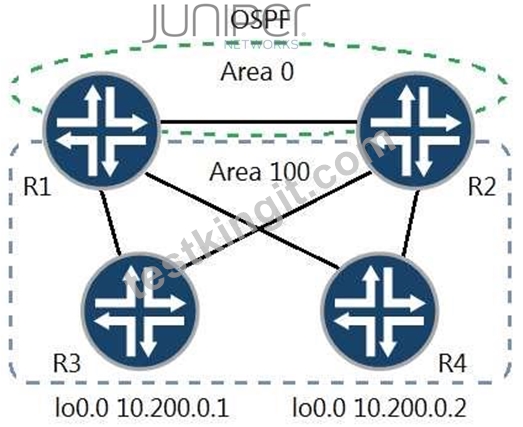
Traffic is being sent from R2 to R3. The link between R2 and R3 fails.
Referring to the exhibit, which statement is correct?
- A. Traffic will automatically reroute using R2 to R4 to R1 to R3.
- B. Traffic will automatically reroute distributed between all available paths.
- C. Manual intervention is required for traffic to be rerouted.
- D. Traffic will automatically reroute using the shortest path, which is R2 to R1 to R3.
Answer: A
NEW QUESTION 23
Exhibit:
Referring to the exhibit, which two statements are true? (Choose two.)
- A. The vrf-target configuration allows routes to be shared between CE-1 and CE-2.
- B. The route-distinguisher configuration allows routes to be shared between CE-1 and CE-2.
- C. The vrf-target configuration stops routes from being shared between CE-1 and CE-2.
- D. The route-distinguisher configuration stops routes from being shared between CE-1 and CE-2.
Answer: B,C
NEW QUESTION 24
You are considering different MPLS VPN connectivity options of a new customer deployment Your customer requires shared LSPs Layer 2 connectivity and auto-provisioning Which type of VPN satisfies the requirements?
- A. LDP Layer 2 circuits
- B. BGP Layer 3 VPNs
- C. BGP Layer 2 VPNs
- D. circuit cross-connects
Answer: C
NEW QUESTION 25 
You manage an MX Series device which includes the configuration shown in the exhibit. Traffic marked with DSCP 000011 is entering the ge-1/0/4 interface at 102 Mbps. The traffic exits the device on the ge-1/0/5 interface. No other traffic is transiting the router.
In this scenario, what happens to traffic exceeding 100 Mbps?
- A. Traffic exceeding 100 Mbps is dropped.
- B. Traffic exceeding 100 Mbps is redirected to a rate limiter.
- C. Traffic exceeding 100 Mbps is buffered.
- D. Traffic exceeding 100 Mbps is forwarded.
Answer: A
NEW QUESTION 26
Exhibit:
Referring to the exhibit, which two statements about route reflectors are correct? (Choose two.)
- A. RR1 and RR2 need the same cluster ID to exchange routes learned from their clients.
- B. RR2 adds its cluster ID when advertising routes from CHent4 to Client3.
- C. RR1 advertises routes learned from Client1 to RR2 with itself as the next hop.
- D. RR2 advertises routes learned from Client3 to EBGP2 with itself as the next hop.
Answer: B,D
NEW QUESTION 27
Click the Exhibit button.
A network administrator is investigating why traffic from R2 is not being forwarded to R1 Referring to the show isis database command output shown in the exhibit, what is causing this problem on the network?
- A. R1 is configured to drop all incoming traffic.
- B. R1 and R2 are in different IS-IS areas.
- C. The preferred interface between R1 and R2 is experiencing errors
- D. R2 is ignoring specific LSPs from R1 in its SPF calculations.
Answer: D
NEW QUESTION 28
Exhibit.
R2 has IS-IS adjacencies with R3 and R4 You want to ensure that R2 has both a level 1 and level 2 adjacency to both R3 and R4 but R2 only has one adjacency with R4.
Referring to the exhibit, which configuration change will solve this issue?
- A. Change the IS-IS area on R2 to match R4.
- B. Change the IS-IS area on R4 to match R2
- C. Remove the level 1 disable configuration from R4
- D. Remove the level 1 disable configuration from R2
Answer: B
NEW QUESTION 29
Exhibit:
Which two statements regarding the output shown in the exhibit are correct? (Choose two.)
- A. The PEs have matching control word values.
- B. The type of connection is remote.
- C. The type of connection is local.
- D. The label associated with this virtual circuit is out of range.
Answer: A,B
NEW QUESTION 30
Exhibit:
CE-1, CE-2, and CE-3 are part of a single VPLS VPN An Ethernet frame has just arrived at PE-3 from CE-3. It has a source MAC address of CE-3 and a destination MAC address of CE-1. You want to know what PE-3 does with the Ethernet frame.
Referring to the exhibit, which statement is correct?
- A. It forwards the packet to PE-1 and PE-2.
- B. It drops the packet because the destination MAC address is not for PE-3.
- C. It forwards the packet to PE-1 only.
- D. It drops the packet because the destination MAC address is not in PE-3's MAC table.
Answer: A
Explanation:
The difference is that, for VPLS, packets can traverse the service provider networks in point-to-multipoint fashion, meaning that a packet originating from a CE device can be broadcast to all the PE routers participating in a VPLS routing instance. In contrast, a Layer 2 VPN forwards packets in point-to-point fashion.
NEW QUESTION 31
Exhibit:
All adjacencies have been formed, no extra options have been configured, and no policies have been written.
Referring to the exhibit, which two statements are correct? (Choose two.)
- A. R1 cannot reach R5
- B. R1 can reach R5.
- C. R1 will create its own default route that points to R2
- D. R2 will create a default route and send it as a TLV to R1
Answer: B,D
Explanation:
https://www.juniper.net/documentation/us/en/software/junos/is-is/topics/concept/is-is-routing-overview.html#routing-is-is-overview__d8374e173 L1
NEW QUESTION 32
Exhibit:
Referring to the exhibit, hosts in Site 1 and Site 2 are unable to communicate with each other through the Layer 3 VPN.
What is the problem?
- A. The two sites are using the same route distinguishes.
- B. The two sites are using the same instance type.
- C. The two sites are using the same route target.
- D. The two sites are in the same AS.
Answer: D
NEW QUESTION 33
You are responsible for configuring CoS for your network Your network includes a video application with strict latency requirements, so that any packets delayed by more than 75 ms are effectively useless. You want to ensure that you do not waste buffer space.
When configuring the scheduler for this application, which feature would you use?
- A. rate limit
- B. temporal
- C. remainder
- D. exact
Answer: B
Explanation:
A period of time, value in microseconds. When you configure a temporal buffer, you must also configure a transmit rate. The system calculates the queue buffer size by multiplying the available bandwidth of the interface times the configured temporal value and transmit rate. When you specify a temporal method, the drop profile is assigned a static buffer and the system starts dropping packets once the queue buffer size is full. By default, the other buffer types are assigned dynamic buffers that use surplus transmission bandwidth to absorb bursts of traffic.
https://www.juniper.net/documentation/us/en/software/junos/cos-security-devices/topics/concept/cos-scheduler-buffer-size-security-overview.html#scheduler-buffer-size-overview__buffer-alloc-method-section
NEW QUESTION 34
Exhibit.
You have a Layer 3 VPN established between PE-1 and PE-2 to allow communication between CE-1 and CE-2 You want to establish communication between CE-1 and CE-2.
Referring to the exhibit, which statement is correct?
- A. You will need a BGP export policy on PE-1 to redistribute the OSPF routes learned from PE-2 to the CE1 BGP neighbor
- B. You will need a VRF import policy on PE-1 to receive the OSPF routes learned from PE-2. through the Layer 3 VPN
- C. You will need a VRF import policy on PE-2 to advertise the OSPF routes learned from CE-2 through the Layer 3 VPN
- D. You will need a VRF export policy on PE-2 to redistribute the OSPF routes learned from CE-2. through the Layer 3 VPN
Answer: D
NEW QUESTION 35
What information is stored in a VRF table for a BGP Layer 2 VPN? (Choose three.)
- A. logical interlace provisioned to local CE device
- B. local site ID
- C. remote interface of local CE device
- D. Layer 2 encapsulation
- E. label-switched path
Answer: A,B,D
Explanation:
The VRF table is populated with information provisioned for the local CE device and contains:
The local site ID
The site's layer 2 encapsulation
The logical interfaces provisioned to the local CE device
A label base used to associated received traffic with one of the logical interfaces
NEW QUESTION 36
Exhibit:
Referring to the exhibit, which three statements about route 10.222/16 are correct when using the default BGP advertisement rules? (Choose three)
- A. R1 will advertise 10.222/16 to R2 with itself as the next hop.
- B. R2 will advertise 10.222/16 to R4 with itself as the next hop.
- C. R7 will advertise 10.222/16 to R9 with itself as the next hop..
- D. R2 will prepend AS10 when advertising 10.222/16 to R7.
- E. R1 will prepend AS10 when advertising 10.222/16 to R2.
Answer: A,B,D
Explanation:
https://kb.juniper.net/InfoCenter/index?page=content&id=KB34964&cat=BGP&actp=LIST
NEW QUESTION 37
Exhibit.
A network designer wants to ensure that traffic from R2 destined for 2001 db9:ffff:ff00. '62 always traverses the R2-R1 link it that link is available Referring to the exhibit, which configuration change will satisfy this requirement?
A)
B)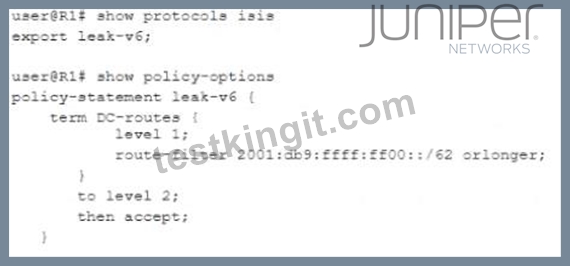
C)
D)
- A. Option A
- B. Option D
- C. Option B
- D. Option C
Answer: D
NEW QUESTION 38
Exhibit:
Referring to the exhibit, hosts in Site 1 and Site 2 are unable to communicate with each other through the Layer 3 VPN.
What is the problem?
- A. The two sites are using the same route distinguishes.
- B. The two sites are using the same instance type.
- C. The two sites are using the same route target.
- D. The two sites are in the same AS.
Answer: D
NEW QUESTION 39
Exhibit:
The exhibit shows a BGP peering session for two PE routers. The BGP session is up, but the hosts in the Layer 2 VPN that uses the BGP session are unable to communicate.
What is the problem in this situation?
- A. The local BGP router does not support Layer 2 VPN and Layer 3 VPN NLRI address families at the same time.
- B. The BGP peer does not support the restarter functionality.
- C. The BGP peer does not support the add-path feature.
- D. There is a mismatch in the supported NLRI address families between the BGP peers.
Answer: D
NEW QUESTION 40
Click the Exhibit button.
A network administrator is investigating why traffic from R2 is not being forwarded to R1 Referring to the show isis database command output shown in the exhibit, what is causing this problem on the network?
- A. R1 is configured to drop all incoming traffic.
- B. R1 and R2 are in different IS-IS areas.
- C. The preferred interface between R1 and R2 is experiencing errors
- D. R2 is ignoring specific LSPs from R1 in its SPF calculations.
Answer: D
NEW QUESTION 41
Exhibit:
CE-1, CE-2, and CE-3 are part of a single VPLS VPN An Ethernet frame has just arrived at PE-3 from CE-3.
It has a source MAC address of CE-3 and a destination MAC address of CE-1. You want to know what PE-3 does with the Ethernet frame.
Referring to the exhibit, which statement is correct?
- A. It forwards the packet to PE-1 and PE-2.
- B. It drops the packet because the destination MAC address is not for PE-3.
- C. It forwards the packet to PE-1 only.
- D. It drops the packet because the destination MAC address is not in PE-3's MAC table.
Answer: A
NEW QUESTION 42
Exhibit:
Referring to the exhibit, external routes are being received at R1. These routes must appear on R5.
Which action will produce this result?
- A. Write an export policy on R4 from level 2 to level 1 matching the external routes.
- B. Turn on wide metrics on R4 and R5 and write an export policy on R2 from level 1 to level 2 matching the external routes.
- C. Write an export policy on R2 from level 1 to level 2 matching the external routes.
- D. Turn on wide metrics on R1 and R2 and write an export policy on R4 from level 2 to level 1 matching the external routes.
Answer: D
NEW QUESTION 43
Exhibit:
A Layer 3 VPN exists in the provider network and the CE devices are connecting to the PE devices using BGP. The PE devices are receiving BGP routes from the CE devices and the PE devices have the CE BGP routes in their respective routing tables. However, the remote CE devices are not receiving the BGP routes.
Referring to the exhibit, what is the problem?
- A. The CE devices are detecting an AS loop
- B. The PE devices are detecting an AS loop.
- C. A route distinguisher mismatch exists.
- D. A VRF target community mismatch exists.
Answer: A
NEW QUESTION 44
Exhibit:
A network administrator is concerned about the number of LSAs that they are observing on the network.
What will reduce Type 7 LSAs advertised from R2 to the non-backbone routers shown in the exhibit?
- A. Configure no-naaa-abr under protocols ospf3 on R2.
- B. Configure nssa under area 0.0.0.2 on R2.
- C. Configure no-summaries under area 0.0.0.2 on R2.
- D. Configure no-summaries under protocols ospf3 on R2.
Answer: A
NEW QUESTION 45
Exhibit:
You have the Layer 2 VPN configuration shown in the exhibit. You are asked to determine the remote site ID for ge-1/0/1.512.
In this scenario, what is the remote site ID?
- A. 0
- B. 1
- C. 2
- D. 3
Answer: B
NEW QUESTION 46
......
Juniper JN0-663 Exam Syllabus Topics:
| Topic | Details |
|---|---|
| Topic 1 |
|
| Topic 2 |
|
| Topic 3 |
|
| Topic 4 |
|
| Topic 5 |
|
| Topic 6 |
|
| Topic 7 |
|
| Topic 8 |
|
| Topic 9 |
|
| Topic 10 |
|
| Topic 11 |
|
Exam Dumps JN0-663 Practice Free Latest Juniper Practice Tests: https://selftestengine.testkingit.com/Juniper/latest-JN0-663-exam-dumps.html