

Feb-2024 Microsoft DP-300 Actual Questions and Braindumps
DP-300 Dumps To Pass Microsoft Exam in 24 Hours - TestKingsIT
Microsoft DP-300 exam is a professional-level certification that validates the skills and knowledge required to administer relational databases on the Microsoft Azure cloud platform. DP-300 exam is designed for database administrators who are responsible for managing and maintaining databases on Azure, and who have experience with SQL Server and Azure data services. DP-300 exam assesses the ability to implement security, backup and recovery, high availability, and performance tuning solutions for Azure databases.
Further Certification Path
The Microsoft Certified: Azure Database Administrator Associate certification gives you a chance to jumpstart your career by taking expert-level certificates. The options available on the Azure track include Microsoft Certified: Azure Data Engineer Associate, Microsoft Certified: Azure Solutions Architect Expert, and others.
NEW QUESTION # 103
You have the following Azure Resource Manager template.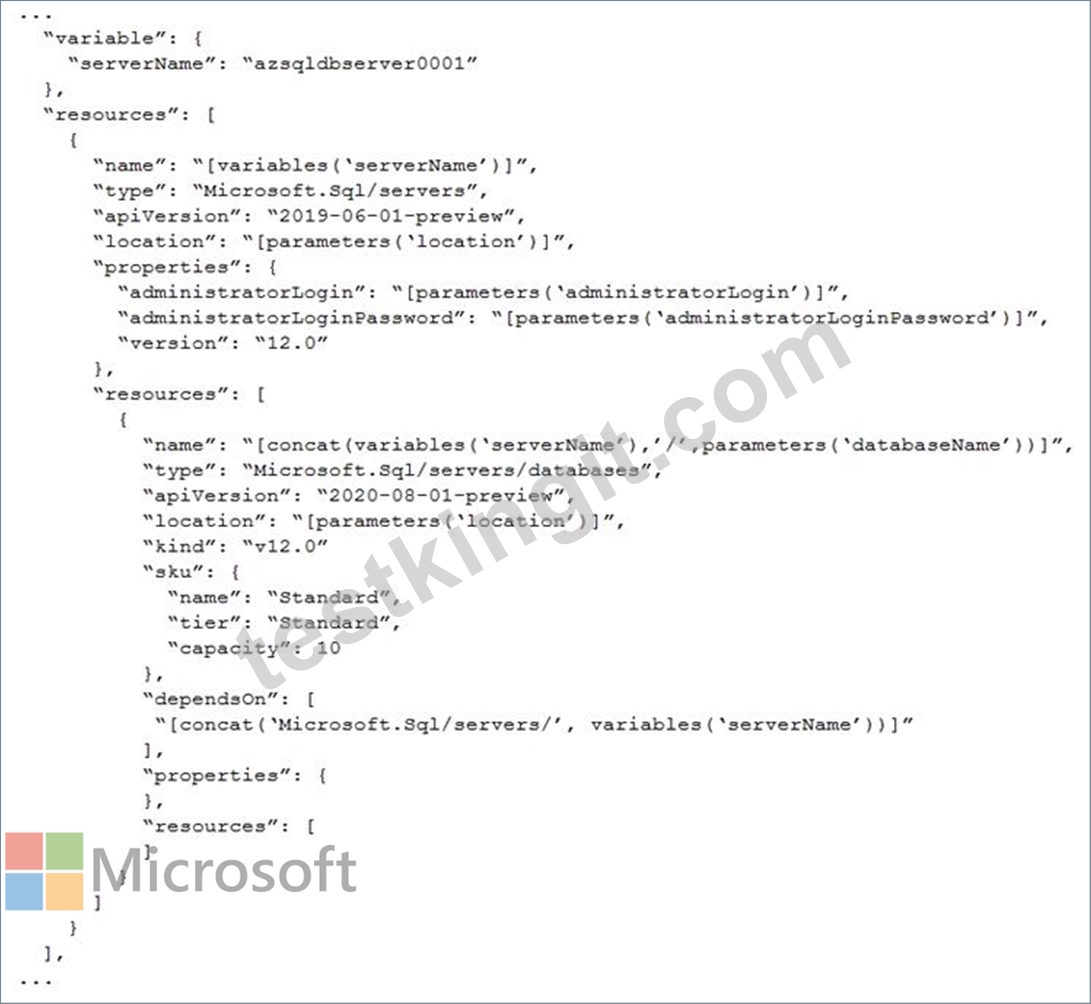
For each of the following statements, select Yes if the statement is true. Otherwise, select No.
NOTE: Each correct selection is worth one point.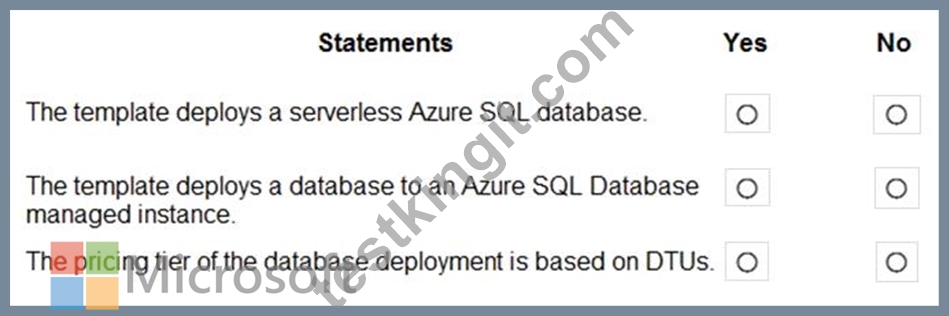
Answer:
Explanation:
Reference:
https://docs.microsoft.com/en-us/azure/azure-sql/database/purchasing-models
https://docs.microsoft.com/en-us/azure/azure-sql/database/single-database-create-arm-template-quickstart
NEW QUESTION # 104
You are planning the migration of the SERVER1 databases. The solution must meet the business requirements.
What should you include in the migration plan? To answer, select the appropriate options in the answer area.
NOTE: Each correct selection is worth one point.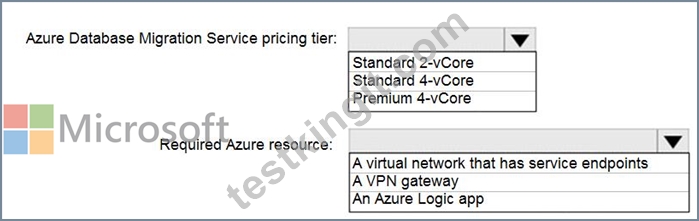
Answer:
Explanation:
Reference:
https://azure.microsoft.com/pricing/details/database-migration/
https://docs.microsoft.com/en-us/azure/dms/tutorial-sql-server-azure-sql-online
Topic 1, Litware
Existing Environment
Network Environment
The manufacturing and research datacenters connect to the primary datacenter by using a VPN.
The primary datacenter has an ExpressRoute connection that uses both Microsoft peering and private peering. The private peering connects to an Azure virtual network named HubVNet.
Identity Environment
Litware has a hybrid Azure Active Directory (Azure AD) deployment that uses a domain named litwareinc.com. All Azure subscriptions are associated to the litwareinc.com Azure AD tenant.
Database Environment
The sales department has the following database workload:
An on-premises named SERVER1 hosts an instance of Microsoft SQL Server 2012 and two 1-TB databases.
A logical server named SalesSrv01A contains a geo-replicated Azure SQL database named SalesSQLDb1. SalesSQLDb1 is in an elastic pool named SalesSQLDb1Pool. SalesSQLDb1 uses database firewall rules and contained database users.
An application named SalesSQLDb1App1 uses SalesSQLDb1.
The manufacturing office contains two on-premises SQL Server 2016 servers named SERVER2 and SERVER3. The servers are nodes in the same Always On availability group. The availability group contains a database named ManufacturingSQLDb1 Database administrators have two Azure virtual machines in HubVnet named VM1 and VM2 that run Windows Server 2019 and are used to manage all the Azure databases.
Licensing Agreement
Litware is a Microsoft Volume Licensing customer that has License Mobility through Software Assurance.
Current Problems
SalesSQLDb1 experiences performance issues that are likely due to out-of-date statistics and frequent blocking queries.
Requirements
Planned Changes
Litware plans to implement the following changes:
Implement 30 new databases in Azure, which will be used by time-sensitive manufacturing apps that have varying usage patterns. Each database will be approximately 20 GB.
Create a new Azure SQL database named ResearchDB1 on a logical server named ResearchSrv01. ResearchDB1 will contain Personally Identifiable Information (PII) data.
Develop an app named ResearchApp1 that will be used by the research department to populate and access ResearchDB1.
Migrate ManufacturingSQLDb1 to the Azure virtual machine platform.
Migrate the SERVER1 databases to the Azure SQL Database platform.
Technical Requirements
Litware identifies the following technical requirements:
Maintenance tasks must be automated.
The 30 new databases must scale automatically.
The use of an on-premises infrastructure must be minimized.
Azure Hybrid Use Benefits must be leveraged for Azure SQL Database deployments.
All SQL Server and Azure SQL Database metrics related to CPU and storage usage and limits must be analyzed by using Azure built-in functionality.
Security and Compliance Requirements
Litware identifies the following security and compliance requirements:
Store encryption keys in Azure Key Vault.
Retain backups of the PII data for two months.
Encrypt the PII data at rest, in transit, and in use.
Use the principle of least privilege whenever possible.
Authenticate database users by using Active Directory credentials.
Protect Azure SQL Database instances by using database-level firewall rules.
Ensure that all databases hosted in Azure are accessible from VM1 and VM2 without relying on public endpoints.
Business Requirements
Litware identifies the following business requirements:
Meet an SLA of 99.99% availability for all Azure deployments.
Minimize downtime during the migration of the SERVER1 databases.
Use the Azure Hybrid Use Benefits when migrating workloads to Azure.
Once all requirements are met, minimize costs whenever possible.
NEW QUESTION # 105
You have an Azure Data Lake Storage Gen2 container.
Data is ingested into the container, and then transformed by a data integration application. The data is NOT modified after that. Users can read files in the container but cannot modify the files.
You need to design a data archiving solution that meets the following requirements:
New data is accessed frequently and must be available as quickly as possible.
Data that is older than five years is accessed infrequently but must be available within one second when requested.
Data that us older than seven years is NOT accessed. After seven years, the data must be persisted at the lowest cost possible.
Costs must be minimized while maintaining the required availability.
How should you manage the data? To answer, select the appropriate options in the answer area.
NOTE: Each correct selection is worth one point.
Answer:
Explanation:
Reference:
https://docs.microsoft.com/en-us/azure/storage/blobs/storage-blob-storage-tiers
NEW QUESTION # 106
You have an Azure Synapse Analytics dedicated SQL pool named Pool1 and an Azure Data Lake Storage Gen2 account named Account1.
You plan to access the files in Account1 by using an external table.
You need to create a data source in Pool1 that you can reference when you create the external table.
How should you complete the Transact-SQL statement? To answer, select the appropriate options in the answer area.
NOTE: Each correct selection is worth one point.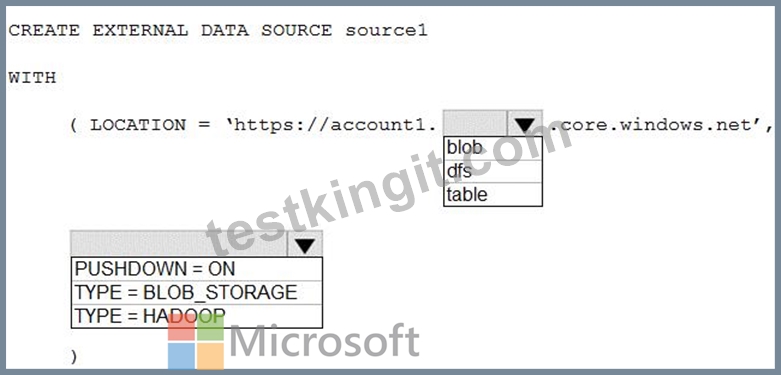
Answer:
Explanation:
Reference:
https://docs.microsoft.com/en-us/azure/synapse-analytics/sql/develop-tables-external-tables
NEW QUESTION # 107
You have an Azure SQL database.
You discover that the plan cache is full of compiled plans that were used only once.
You run theselect * from sys.database_scoped_configurationsTransact-SQL command and receive the results shown in the following table.
You need relieve the memory pressure.
What should you configure?
- A. ACCELERATED_PLAN_FORCING
- B. OPTIMIZE_FOR_AD_HOC_WORKLOADS
- C. LEGACY_CARDINALITY_ESTIMATION
- D. QUERY_OPTIMIZER_HOTFIXES
Answer: B
Explanation:
Explanation
OPTIMIZE_FOR_AD_HOC_WORKLOADS = { ON | OFF }
Enables or disables a compiled plan stub to be stored in cache when a batch is compiled for the first time. The default is OFF. Once the database scoped configuration OPTIMIZE_FOR_AD_HOC_WORKLOADS is enabled for a database, a compiled plan stub will be stored in cache when a batch is compiled for the first time.
Plan stubs have a smaller memory footprint compared to the size of the full compiled plan.
Reference:
https://docs.microsoft.com/en-us/sql/t-sql/statements/alter-database-scoped-configuration-transact-sql
NEW QUESTION # 108
You have SQL Server on an Azure virtual machine named SQL1.
SQL1 has an agent job to back up all databases.
You add a user named dbadmin1 as a SQL Server Agent operator.
You need to ensure that dbadmin1 receives an email alert if a job fails.
Which three actions should you perform in sequence? To answer, move the appropriate actions from the list of actions to the answer area and arrange them in the correct order.
Answer:
Explanation:
Explanation
Step 1: Enable the email settings for the SQL Server Agent.
To send a notification in response to an alert, you must first configure SQL Server Agent to send mail.
Step 2: Create a job alert
Step 3: Create a job notification
Example:
-- adds an e-mail notification for the specified alert (Test Alert)
-- This example assumes that Test Alert already exists
-- and that Francois Ajenstat is a valid operator name.
USE msdb ;
GO
EXEC dbo.sp_add_notification
@alert_name = N'Test Alert',
@operator_name = N'Francois Ajenstat',
@notification_method = 1 ;
GO
Reference:
https://docs.microsoft.com/en-us/sql/ssms/agent/notify-an-operator-of-job-status
https://docs.microsoft.com/en-us/sql/ssms/agent/assign-alerts-to-an-operator
NEW QUESTION # 109
You have an Azure SQL managed instance named SQLMI1 that has Resource Governor enabled and is used by two apps named App1 and App2.
You need to configure SQLMI1 to limit the CPU and memory resources that can be allocated to App1.
Which four actions should you perform in sequence? To answer, move the appropriate actions from the list of actions to the answer area and arrange them in the correct order.
Answer:
Explanation:
1 - Create a resource pool.
2 - Create a worklaod group.
3 - Create a user-defined classifier function.
4 - Modify Resource Governor.
Reference:
https://docs.microsoft.com/en-us/sql/relational-databases/resource-governor/resource-governor?view=sql-server-ver15
https://docs.microsoft.com/en-us/sql/relational-databases/resource-governor/create-and-test-a-classifier-user-defined-function?view=sql-server-ver15
NEW QUESTION # 110
You need to recommend an availability strategy for an Azure SQL database. The strategy must meet the following requirements:
Support failovers that do not require client applications to change their connection strings.
Replicate the database to a secondary Azure region.
Support failover to the secondary region.
What should you include in the recommendation?
- A. failover groups
- B. Availability Zones
- C. geo-replication
- D. transactional replication
Answer: A
Explanation:
Active geo-replication is an Azure SQL Database feature that allows you to create readable secondary databases of individual databases on a server in the same or different data center (region).
Incorrect Answers:
C: Availability Zones are unique physical locations within a region. Each zone is made up of one or more datacenters equipped with independent power, cooling, and networking.
Reference:
https://docs.microsoft.com/en-us/azure/azure-sql/database/active-geo-replication-overview
NEW QUESTION # 111
You have a SQL Server on Azure Virtual Machines instance named VM1 that hosts a database named DB1. You run the following query.
For each of the following statements, select Yes if the statement is true. Otherwise, select No.
Answer:
Explanation:
NEW QUESTION # 112
You plan to develop a dataset named Purchases by using Azure Databricks. Purchases will contain the following columns:
ProductID
ItemPrice
LineTotal
Quantity
StoreID
Minute
Month
Hour
Year
Day
You need to store the data to support hourly incremental load pipelines that will vary for each StoreID. The solution must minimize storage costs.
How should you complete the code? To answer, select the appropriate options in the answer area.
NOTE: Each correct selection is worth one point.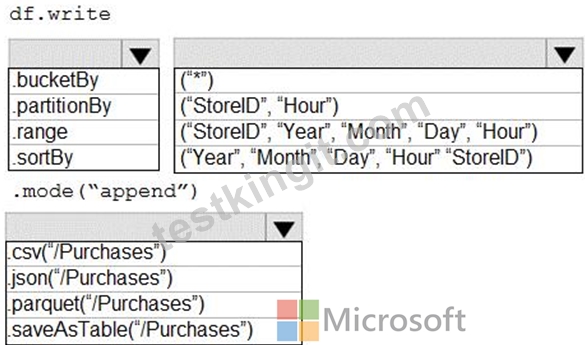
Answer:
Explanation: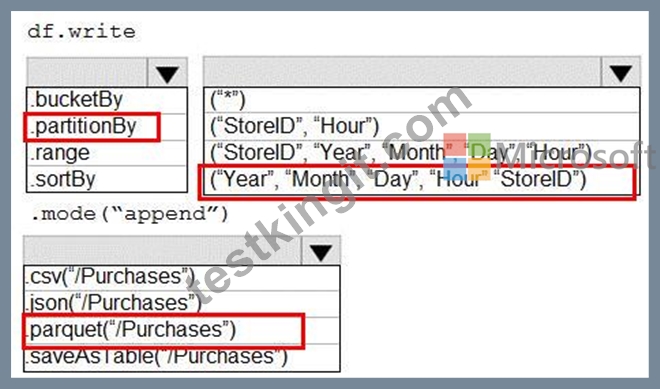
Reference:
https://intellipaat.com/community/11744/how-to-partition-and-write-dataframe-in-spark-without-deleting-partitions-with-no-new-data
NEW QUESTION # 113
You have an Azure subscription.
You plan to deploy a new Azure virtual machine that will host a Microsoft SQL Server instance.
You need to configure the disks on the virtual machine. The solution must meet the following requirements:
* Minimize latency for transaction logs.
* Minimize the impact on IO Of the virtual machine.
Which type of disk should you use for each workload? To answer. drag the appropriate disk types to the correct workloads. Each disk type may be used once, at all. You may need to drag the split bar between panes or scroll to view content.
NOTE: Each correct selection is worth one point.
Answer:
Explanation: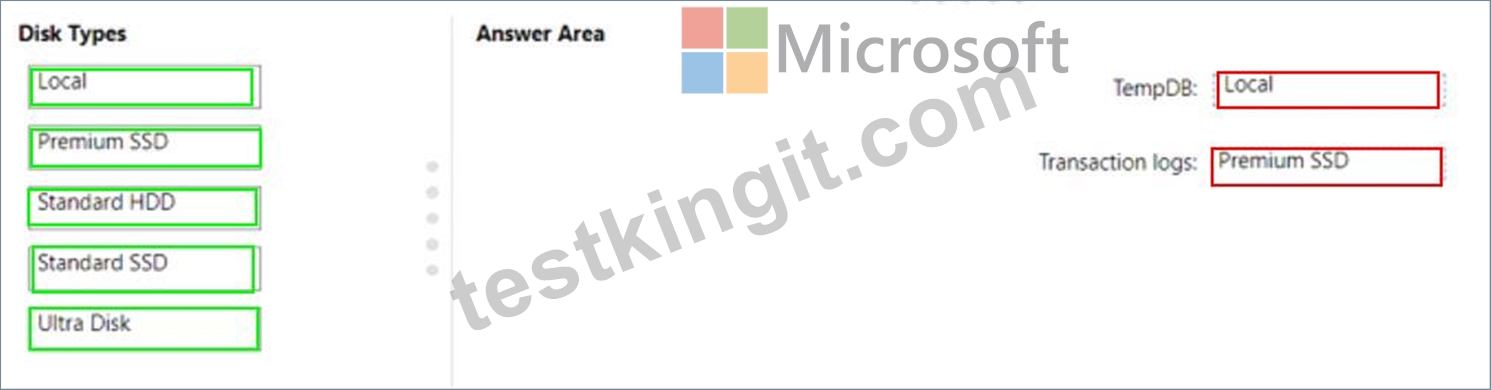
NEW QUESTION # 114
You have the following Transact-SQL query.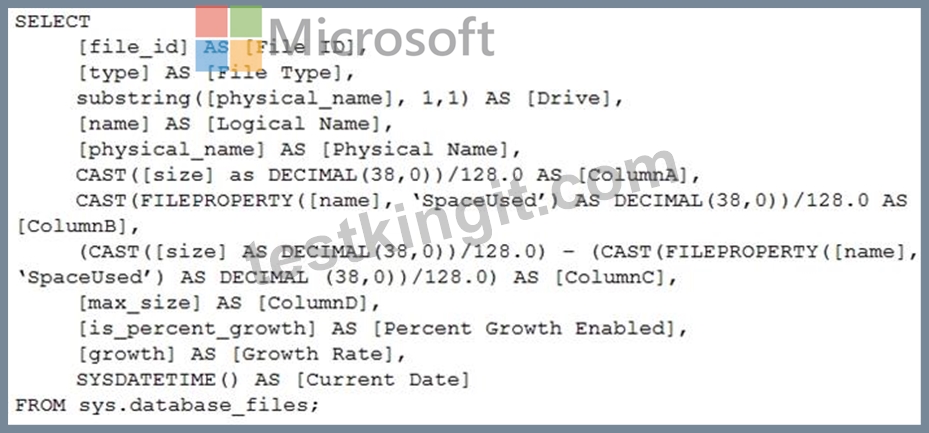
Which column returned by the query represents the free space in each file?
- A. ColumnD
- B. ColumnB
- C. ColumnA
- D. ColumnC
Answer: D
Explanation:
Explanation
Example:
Free space for the file in the below query result set will be returned by the FreeSpaceMB column.
SELECT DB_NAME() AS DbName,
name AS FileName,
type_desc,
size/128.0 AS CurrentSizeMB,
size/128.0 - CAST(FILEPROPERTY(name, 'SpaceUsed') AS INT)/128.0 AS FreeSpaceMB FROM sys.database_files WHERE type IN (0,1); Reference:
https://www.sqlshack.com/how-to-determine-free-space-and-file-size-for-sql-server-databases/
NEW QUESTION # 115
HOTSPOT
You have SQL Server on an Azure virtual machine.
You review the query plan shown in the following exhibit.
For each of the following statements, select yes if the statement is true. Otherwise, select no.
NOTE: Each correct selection is worth one point.
Hot Area: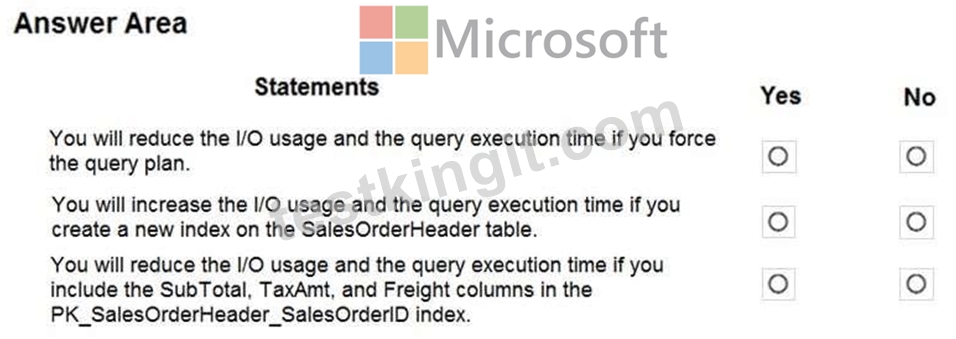
Answer:
Explanation:
Explanation/Reference:
https://docs.microsoft.com/en-us/sql/relational-databases/performance/monitoring-performance-by-using-the- query-store
NEW QUESTION # 116
You are provisioning an Azure SQL database in the Azure portal as shown in the following exhibit.
Use the drop-down menus to select the answer choice that completes each statement based on the information presented in the graphic.
NOTE: Each correct selection is worth one point.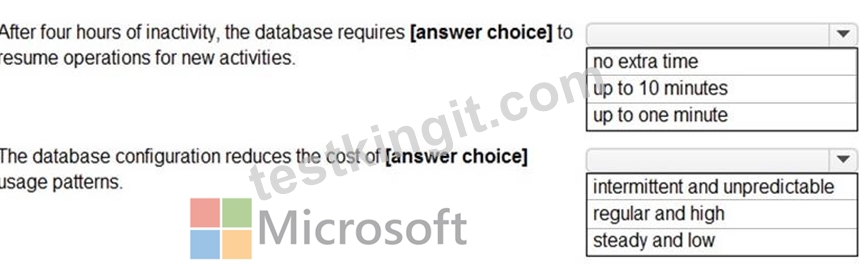
Answer:
Explanation:
Reference:
https://docs.microsoft.com/en-us/azure/azure-sql/database/serverless-tier-overview
NEW QUESTION # 117
You need to implement a solution to notify the administrators. The solution must meet the monitoring requirements.
What should you do?
- A. Add a diagnostic setting that logs Timeouts and streams to an Azure event hub.
- B. Create an Azure Monitor alert rule that has a dynamic threshold and assign the alert rule to an action group.
- C. Add a diagnostic setting that logs QueryStoreRuntimeStatistics and streams to an Azure event hub.
- D. Create an Azure Monitor alert rule that has a static threshold and assign the alert rule to an action group.
Answer: B
Explanation:
Reference:
https://azure.microsoft.com/en-gb/blog/announcing-azure-monitor-aiops-alerts-with-dynamic-thresholds/ This is a case study. Case studies are not timed separately. You can use as much exam time as you would like to complete each case. However, there may be additional case studies and sections on this exam. You must manage your time to ensure that you are able to complete all questions included on this exam in the time provided.
To answer the questions included in a case study, you will need to reference information that is provided in the case study. Case studies might contain exhibits and other resources that provide more information about the scenario that is described in the case study. Each question is independent of the other questions in this case study.
At the end of this case study, a review screen will appear. This screen allows you to review your answers and to make changes before you move to the next section of the exam. After you begin a new section, you cannot return to this section.
To start the case study
To display the first question in this case study, click the Next button. Use the buttons in the left pane to explore the content of the case study before you answer the questions. Clicking these buttons displays information such as business requirements, existing environment, and problem statements. If the case study has an All Information tab, note that the information displayed is identical to the information displayed on the subsequent tabs. When you are ready to answer a question, click the Question button to return to the question.
Overview
ADatum Corporation is a retailer that sells products through two sales channels: retail stores and a website.
NEW QUESTION # 118
You have an Azure SQL managed instance named SQLMI1 that has Resource Governor enabled and is used by two apps named App1 and App2.
You need to configure SQLMI1 to limit the CPU and memory resources that can be allocated to App1.
Which four actions should you perform in sequence? To answer, move the appropriate actions from the list of actions to the answer area and arrange them in the correct order.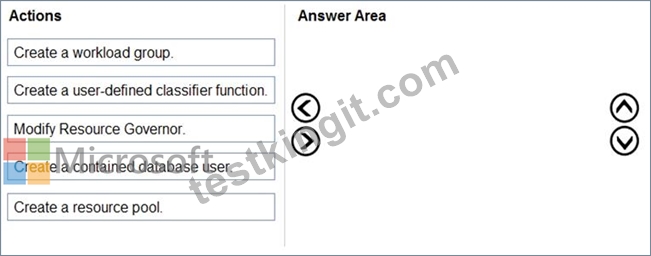
Answer:
Explanation:
1 - Create a resource pool.
2 - Create a workload group.
3 - Create a user-defined classifier function.
4 - Modify Resource Governor.
Reference:
https://docs.microsoft.com/en-us/sql/relational-databases/resource-governor/resource-governor?view=sql-server-ver15
https://docs.microsoft.com/en-us/sql/relational-databases/resource-governor/create-and-test-a-classifier-user-defined-function?view=sql-server-ver15
NEW QUESTION # 119
You need to recommend an availability strategy for an Azure SQL database. The strategy must meet the following requirements:
Support failovers that do not require client applications to change their connection strings.
Replicate the database to a secondary Azure region.
Support failover to the secondary region.
What should you include in the recommendation?
- A. geo-replication
- B. failover groups
- C. Availability Zones
- D. transactional replication
Answer: A
Explanation:
Active geo-replication is an Azure SQL Database feature that allows you to create readable secondary databases of individual databases on a server in the same or different data center (region).
Incorrect Answers:
C: Availability Zones are unique physical locations within a region. Each zone is made up of one or more datacenters equipped with independent power, cooling, and networking.
Reference:
https://docs.microsoft.com/en-us/azure/azure-sql/database/active-geo-replication-overview
NEW QUESTION # 120
You are planning the migration of the SERVER1 databases. The solution must meet the business requirements.
What should you include in the migration plan? To answer, select the appropriate options in the answer area.
NOTE: Each correct selection is worth one point.
Answer:
Explanation: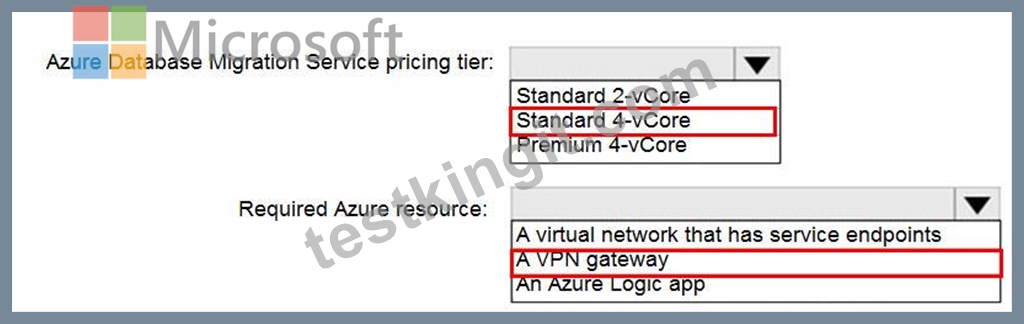
Reference:
https://azure.microsoft.com/pricing/details/database-migration/
https://docs.microsoft.com/en-us/azure/dms/tutorial-sql-server-azure-sql-online
NEW QUESTION # 121
You have a database on a SQL Server on Azure Virtual Machines instance.
The current state of Query Store for the database is shown in the following exhibit.

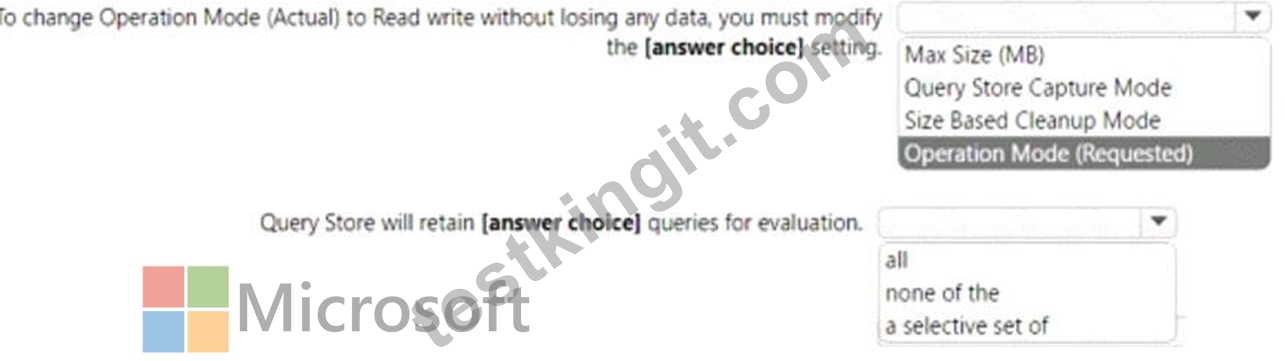
Answer:
Explanation: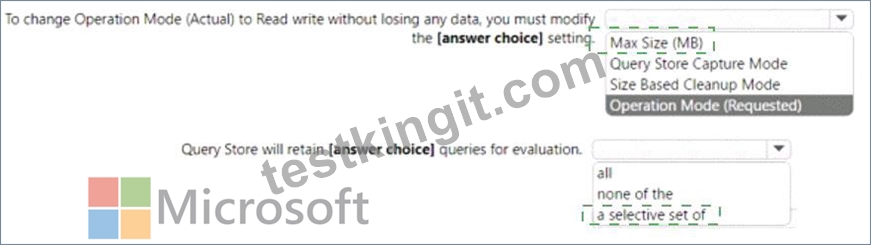
Explanation
Graphical user interface, text Description automatically generated
NEW QUESTION # 122
You need to implement statistics maintenance for SalesSQLDb1. The solution must meet the technical requirements.
Which four actions should you perform in sequence? To answer, move the appropriate actions from the list of actions to the answer area and arrange them in the correct order.
Answer:
Explanation:
Explanation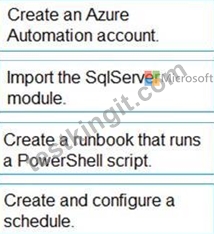
Automating Azure SQL DB index and statistics maintenance using Azure Automation:
1. Create Azure automation account (Step 1)
2. Import SQLServer module (Step 2)
3. Add Credentials to access SQL DB
This will use secure way to hold login name and password that will be used to access Azure SQL DB
4. Add a runbook to run the maintenance (Step 3)
Steps: 1. Click on "runbooks" at the left panel and then click "add a runbook"
2. Choose "create a new runbook" and then give it a name and choose "Powershell" as the type of the runbook and then click on "create"
5. Schedule task (Step 4)
Steps:1. Click on Schedules2. Click on "Add a schedule" and follow the instructions to choose existing schedule or create a new schedule.
Reference:
https://techcommunity.microsoft.com/t5/azure-database-support-blog/automating-azure-sql-db-index-and-statisti
NEW QUESTION # 123
......
Microsoft DP-300 exam is a part of the Azure certification path, which includes other certification exams such as AZ-900 (Azure Fundamentals), AZ-104 (Microsoft Azure Administrator), and AZ-204 (Developing Solutions for Microsoft Azure). Earning the DP-300 certification demonstrates that the candidate has the necessary skills to administer and manage relational databases on Microsoft Azure, making them a valuable asset to any organization that uses cloud-based database solutions.
Download the Latest DP-300 Dump - 2024 DP-300 Exam Question Bank: https://selftestengine.testkingit.com/Microsoft/latest-DP-300-exam-dumps.html