

Get all the Information About Microsoft DP-203 Exam 2026 Practice Test Questions
Check Real Microsoft DP-203 Exam Question for Free (2026)
NEW QUESTION # 162
You have an Azure Synapse Analytics dedicated SQL pool named Pool1 and an Azure Data Lake Storage Gen2 account named Account1.
You plan to access the files in Account1 by using an external table.
You need to create a data source in Pool1 that you can reference when you create the external table.
How should you complete the Transact-SQL statement? To answer, select the appropriate options in the answer area.
NOTE: Each correct selection is worth one point.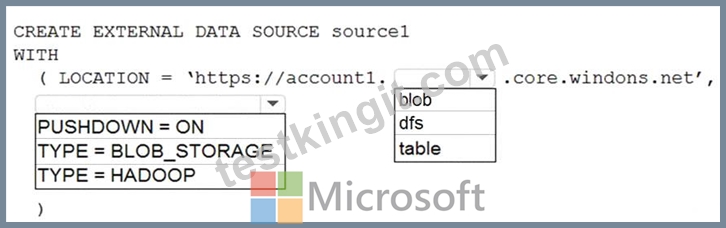
Answer:
Explanation:
Explanation:
Box 1: blob
The following example creates an external data source for Azure Data Lake Gen2 CREATE EXTERNAL DATA SOURCE YellowTaxi WITH ( LOCATION = 'https://azureopendatastorage.blob.core.windows.net/nyctlc/yellow/', TYPE = HADOOP) Box 2: HADOOP Reference:
https://docs.microsoft.com/en-us/azure/synapse-analytics/sql/develop-tables-external-tables
NEW QUESTION # 163
From a website analytics system, you receive data extracts about user interactions such as downloads, link clicks, form submissions, and video plays.
The data contains the following columns.
You need to design a star schema to support analytical queries of the data. The star schema will contain four tables including a date dimension.
To which table should you add each column? To answer, select the appropriate options in the answer area.
NOTE: Each correct selection is worth one point.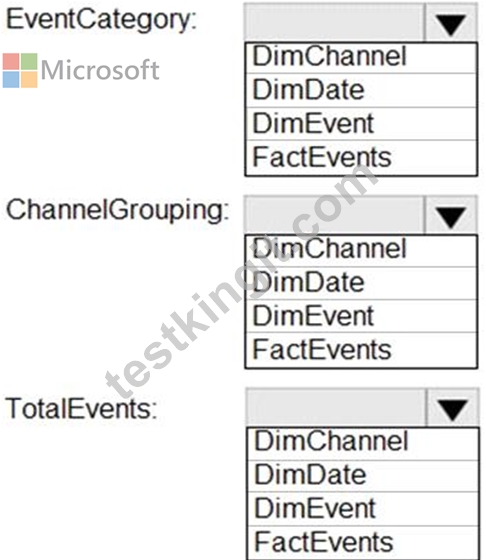
Answer:
Explanation: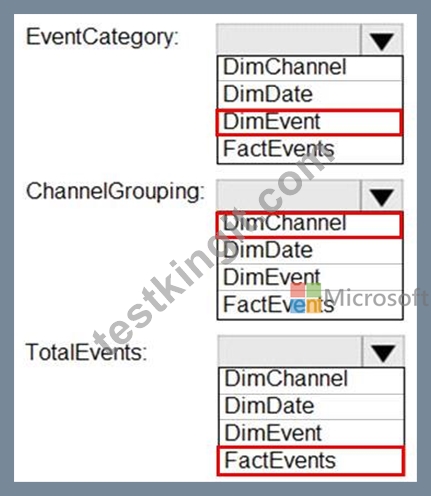
Reference:
https://docs.microsoft.com/en-us/power-bi/guidance/star-schema
NEW QUESTION # 164
You need to implement versioned changes to the integration pipelines. The solution must meet the data integration requirements.
In which order should you perform the actions? To answer, move all actions from the list of actions to the answer area and arrange them in the correct order.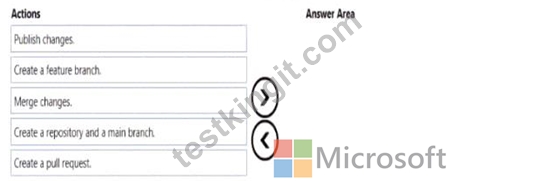
Answer:
Explanation: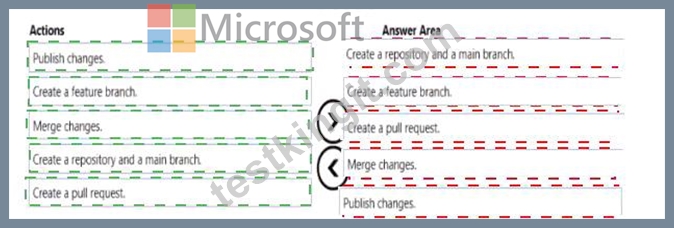
Explanation
Graphical user interface, application Description automatically generated
Scenario: Identify a process to ensure that changes to the ingestion and transformation activities can be version-controlled and developed independently by multiple data engineers.
Step 1: Create a repository and a main branch
You need a Git repository in Azure Pipelines, TFS, or GitHub with your app.
Step 2: Create a feature branch
Step 3: Create a pull request
Step 4: Merge changes
Merge feature branches into the main branch using pull requests.
Step 5: Publish changes
Reference:
https://docs.microsoft.com/en-us/azure/devops/pipelines/repos/pipeline-options-for-git
NEW QUESTION # 165
You have an Azure SQL database named Database1 and two Azure event hubs named HubA and HubB. The data consumed from each source is shown in the following table.
You need to implement Azure Stream Analytics to calculate the average fare per mile by driver.
How should you configure the Stream Analytics input for each source? To answer, select the appropriate options in the answer area.
NOTE: Each correct selection is worth one point.
Answer:
Explanation: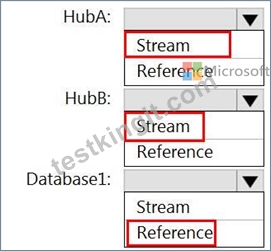
Reference:
https://docs.microsoft.com/en-us/azure/stream-analytics/stream-analytics-use-reference-data
NEW QUESTION # 166
You have an Azure subscription that contains the following resources:
An Azure Active Directory (Azure AD) tenant that contains a security group named Group1 An Azure Synapse Analytics SQL pool named Pool1 You need to control the access of Group1 to specific columns and rows in a table in Pool1.
Which Transact-SQL commands should you use? To answer, select the appropriate options in the answer area.
Answer:
Explanation: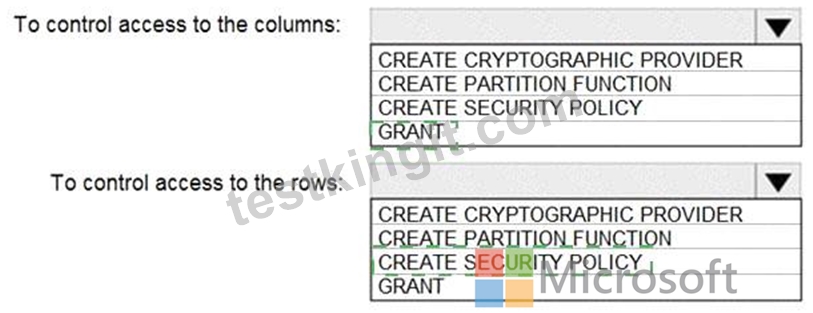
Explanation
Text Description automatically generated
Box 1: GRANT
You can implement column-level security with the GRANT T-SQL statement.
Box 2: CREATE SECURITY POLICY
Implement Row Level Security by using the CREATE SECURITY POLICY Transact-SQL statement Reference:
https://docs.microsoft.com/en-us/azure/synapse-analytics/sql-data-warehouse/column-level-security
NEW QUESTION # 167
You are building a database in an Azure Synapse Analytics serverless SQL pool.
You have data stored in Parquet files in an Azure Data Lake Storage Gen2 container.
Records are structured as shown in the following sample.
{
"id": 123,
"address_housenumber": "19c",
"address_line": "Memory Lane",
"applicant1_name": "Jane",
"applicant2_name": "Dev"
}
The records contain two applicants at most.
You need to build a table that includes only the address fields.
How should you complete the Transact-SQL statement? To answer, select the appropriate options in the answer area.
NOTE: Each correct selection is worth one point.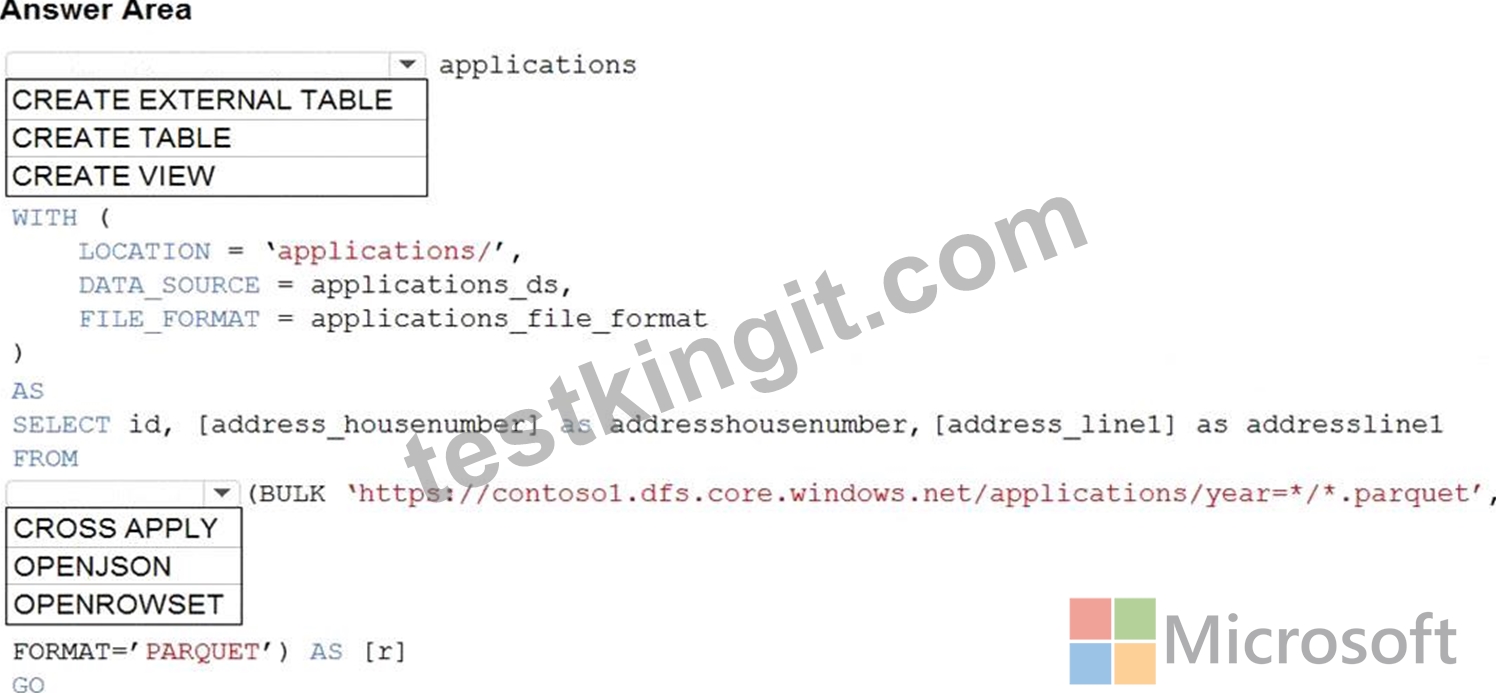
Answer:
Explanation: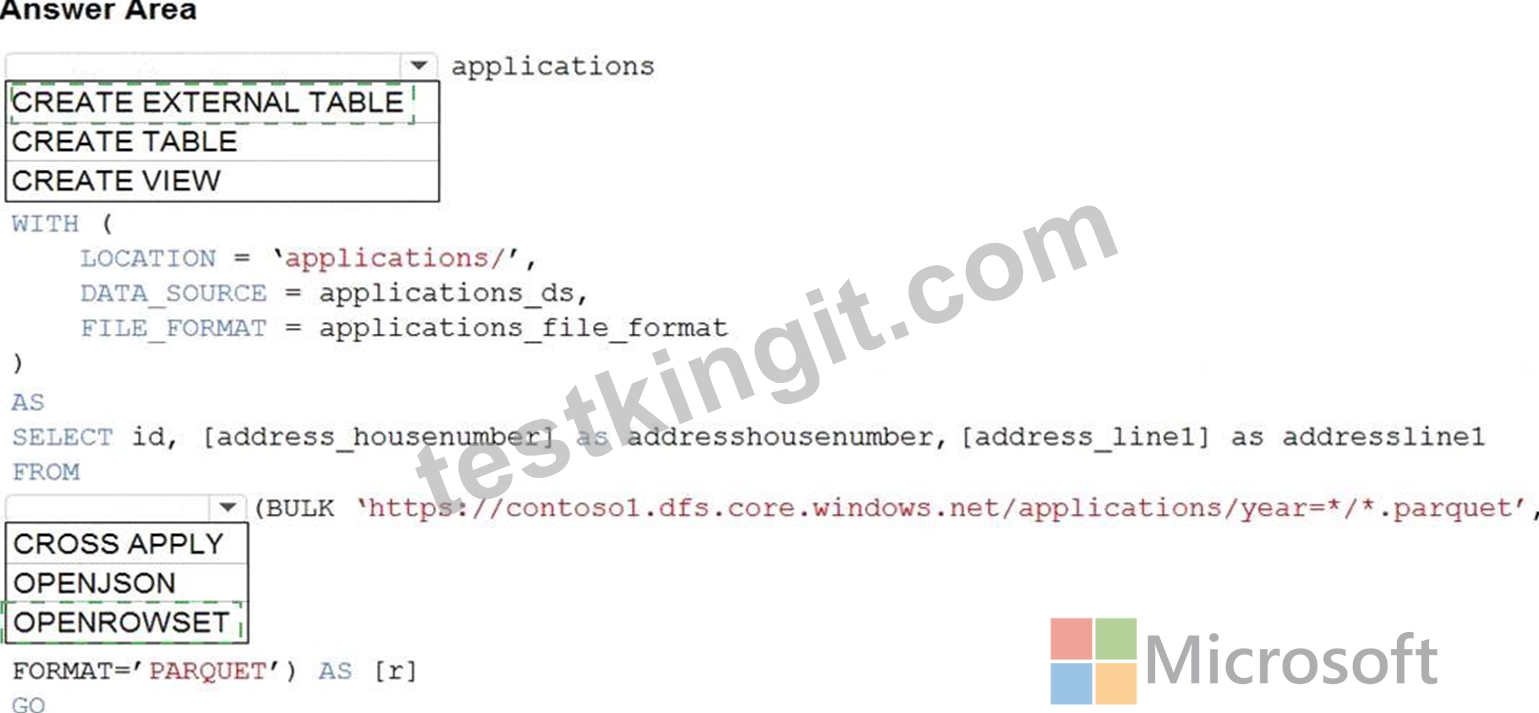
Explanation:
Box 1: CREATE EXTERNAL TABLE
An external table points to data located in Hadoop, Azure Storage blob, or Azure Data Lake Storage. External tables are used to read data from files or write data to files in Azure Storage. With Synapse SQL, you can use external tables to read external data using dedicated SQL pool or serverless SQL pool.
Syntax:
CREATE EXTERNAL TABLE { database_name.schema_name.table_name | schema_name.table_name | table_name } ( <column_definition> [ ,...n ] ) WITH ( LOCATION = 'folder_or_filepath', DATA_SOURCE = external_data_source_name, FILE_FORMAT = external_file_format_name Box 2. OPENROWSET When using serverless SQL pool, CETAS is used to create an external table and export query results to Azure Storage Blob or Azure Data Lake Storage Gen2.
Example:
AS
SELECT decennialTime, stateName, SUM(population) AS population
FROM
OPENROWSET(BULK 'https://azureopendatastorage.blob.core.windows.net/censusdatacontainer/release
/us_population_county/year=*/*.parquet',
FORMAT='PARQUET') AS [r]
GROUP BY decennialTime, stateName
GO
Reference:
https://docs.microsoft.com/en-us/azure/synapse-analytics/sql/develop-tables-external-tables
NEW QUESTION # 168
You have an Azure subscription.
You plan to build a data warehouse in an Azure Synapse Analytics dedicated SQL pool named pool1 that will contain staging tables and a dimensional model Pool1 will contain the following tables.

Answer:
Explanation:
NEW QUESTION # 169
A company uses the Azure Data Lake Storage Gen2 service.
You need to design a data archiving solution that meets the following requirements:
Data that is older than five years is accessed infrequency but must be available within one second when requested.
Data that is older than seven years in NOT accessed.
Costs must be minimized while maintaining the required availability.
How should you manage the data? To answer, select the appropriate option in he answers area.
NOTE: Each correct selection is worth one point.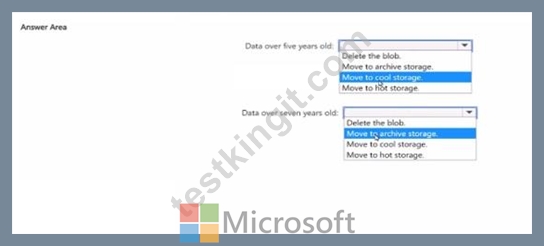
Answer:
Explanation:
NEW QUESTION # 170
You are designing a financial transactions table in an Azure Synapse Analytics dedicated SQL pool. The table will have a clustered columnstore index and will include the following columns:
* TransactionType: 40 million rows per transaction type
* CustomerSegment: 4 million per customer segment
* TransactionMonth: 65 million rows per month
* AccountType: 500 million per account type
You have the following query requirements:
* Analysts will most commonly analyze transactions for a given month.
* Transactions analysis will typically summarize transactions by transaction type, customer segment, and/or account type You need to recommend a partition strategy for the table to minimize query times.
On which column should you recommend partitioning the table?
- A. AccountType
- B. TransactionMonth
- C. CustomerSegment
- D. TransactionType
Answer: D
Explanation:
Explanation
For optimal compression and performance of clustered columnstore tables, a minimum of 1 million rows per distribution and partition is needed. Before partitions are created, dedicated SQL pool already divides each table into 60 distributed databases.
Example: Any partitioning added to a table is in addition to the distributions created behind the scenes. Using this example, if the sales fact table contained 36 monthly partitions, and given that a dedicated SQL pool has
60 distributions, then the sales fact table should contain 60 million rows per month, or 2.1 billion rows when all months are populated. If a table contains fewer than the recommended minimum number of rows per partition, consider using fewer partitions in order to increase the number of rows per partition.
NEW QUESTION # 171
You are developing a solution using a Lambda architecture on Microsoft Azure.
The data at test layer must meet the following requirements:
Data storage:
* Serve as a repository (or high volumes of large files in various formats.
* Implement optimized storage for big data analytics workloads.
* Ensure that data can be organized using a hierarchical structure.
Batch processing:
* Use a managed solution for in-memory computation processing.
* Natively support Scala, Python, and R programming languages.
* Provide the ability to resize and terminate the cluster automatically.
Analytical data store:
* Support parallel processing.
* Use columnar storage.
* Support SQL-based languages.
You need to identify the correct technologies to build the Lambda architecture.
Which technologies should you use? To answer, select the appropriate options in the answer area NOTE: Each correct selection is worth one point.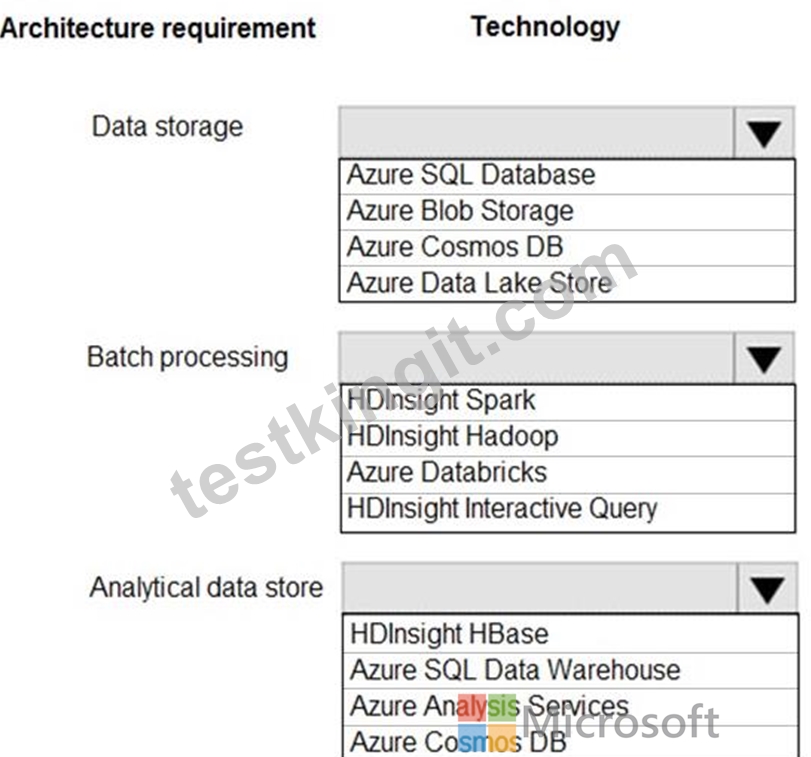
Answer:
Explanation:
Reference:
https://docs.microsoft.com/en-us/azure/storage/blobs/data-lake-storage-namespace
https://docs.microsoft.com/en-us/azure/architecture/data-guide/technology-choices/batch-processing
https://docs.microsoft.com/en-us/azure/sql-data-warehouse/sql-data-warehouse-overview-what-is
NEW QUESTION # 172
You need to build a solution to ensure that users can query specific files in an Azure Data Lake Storage Gen2 account from an Azure Synapse Analytics serverless SQL pool.
Which three actions should you perform in sequence? To answer, move the appropriate actions from the list of actions to the answer area and arrange them in the correct order.
NOTE: More than one order of answer choices is correct. You will receive credit for any of the correct orders you select.
Answer:
Explanation: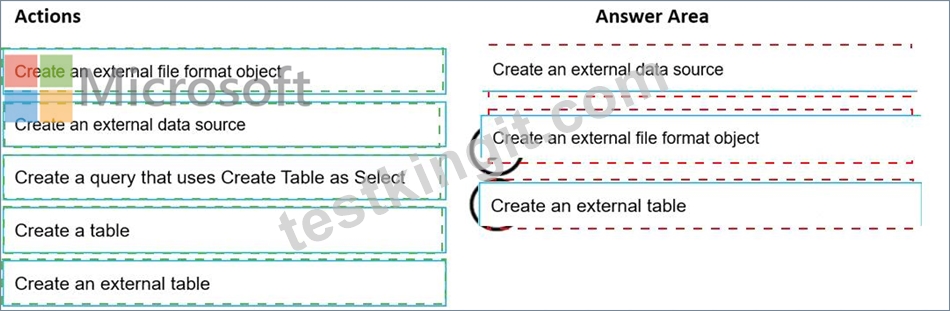
Explanation
Graphical user interface, text, application, email Description automatically generated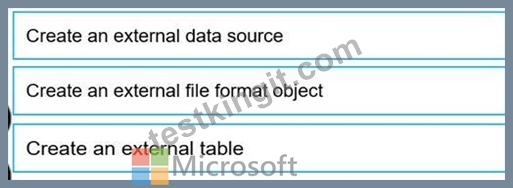
Step 1: Create an external data source
You can create external tables in Synapse SQL pools via the following steps:
* CREATE EXTERNAL DATA SOURCE to reference an external Azure storage and specify the credential that should be used to access the storage.
* CREATE EXTERNAL FILE FORMAT to describe format of CSV or Parquet files.
* CREATE EXTERNAL TABLE on top of the files placed on the data source with the same file format.
Step 2: Create an external file format object
Creating an external file format is a prerequisite for creating an external table.
Step 3: Create an external table
Reference:
https://docs.microsoft.com/en-us/azure/synapse-analytics/sql/develop-tables-external-tables
NEW QUESTION # 173
You have an Azure Synapse Analytics workspace named WS1.
You have an Azure Data Lake Storage Gen2 container that contains JSON-formatted files in the following format.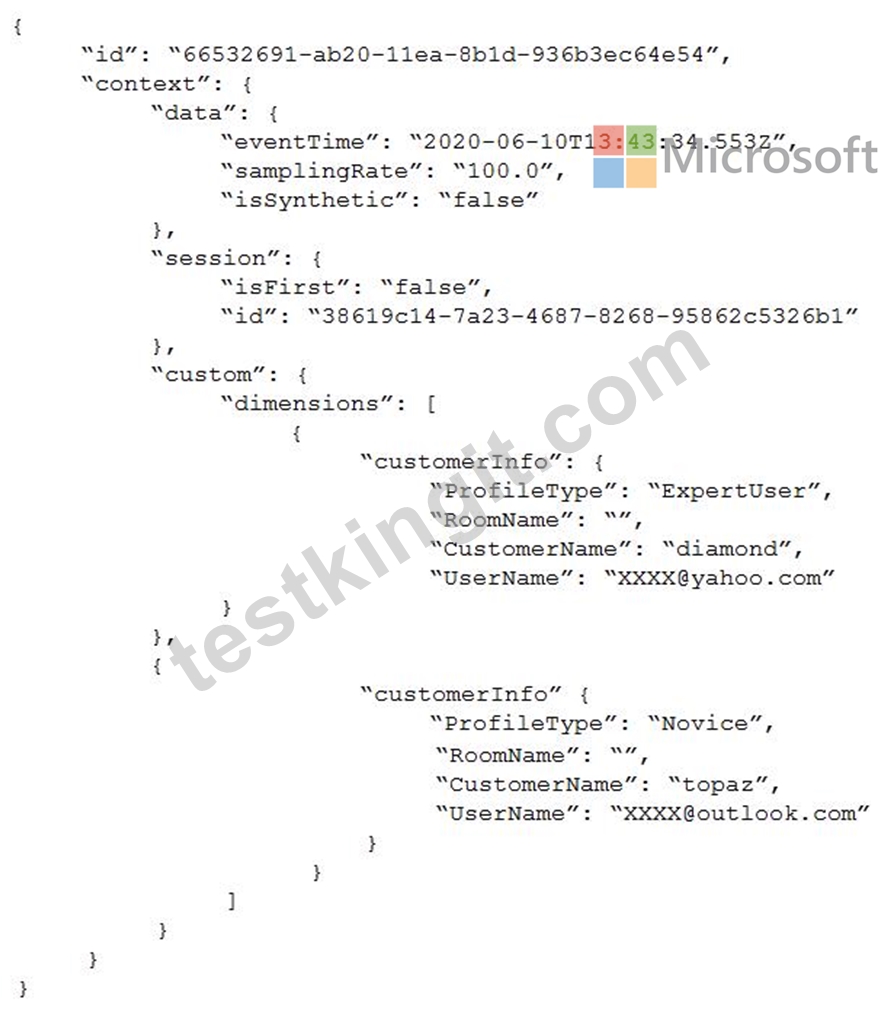
You need to use the serverless SQL pool in WS1 to read the files.
How should you complete the Transact-SQL statement? To answer, drag the appropriate values to the correct targets. Each value may be used once, more than once, or not at all. You may need to drag the split bar between panes or scroll to view content.
NOTE: Each correct selection is worth one point.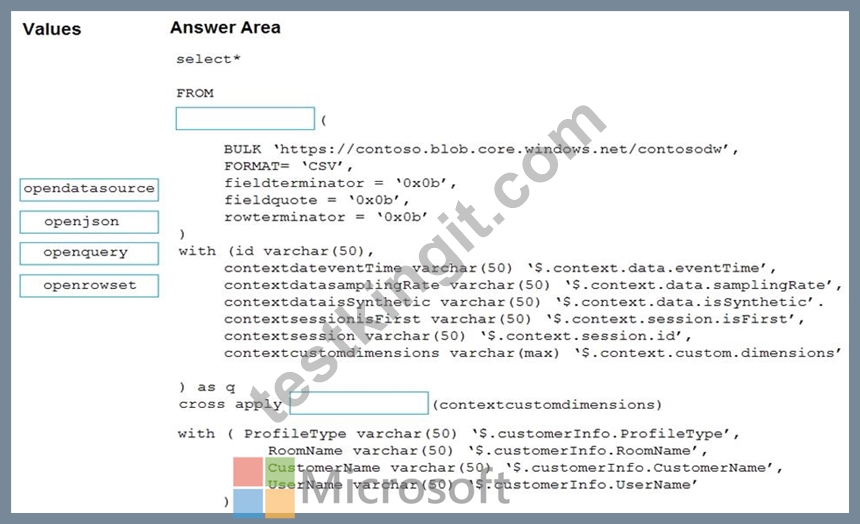
Answer:
Explanation: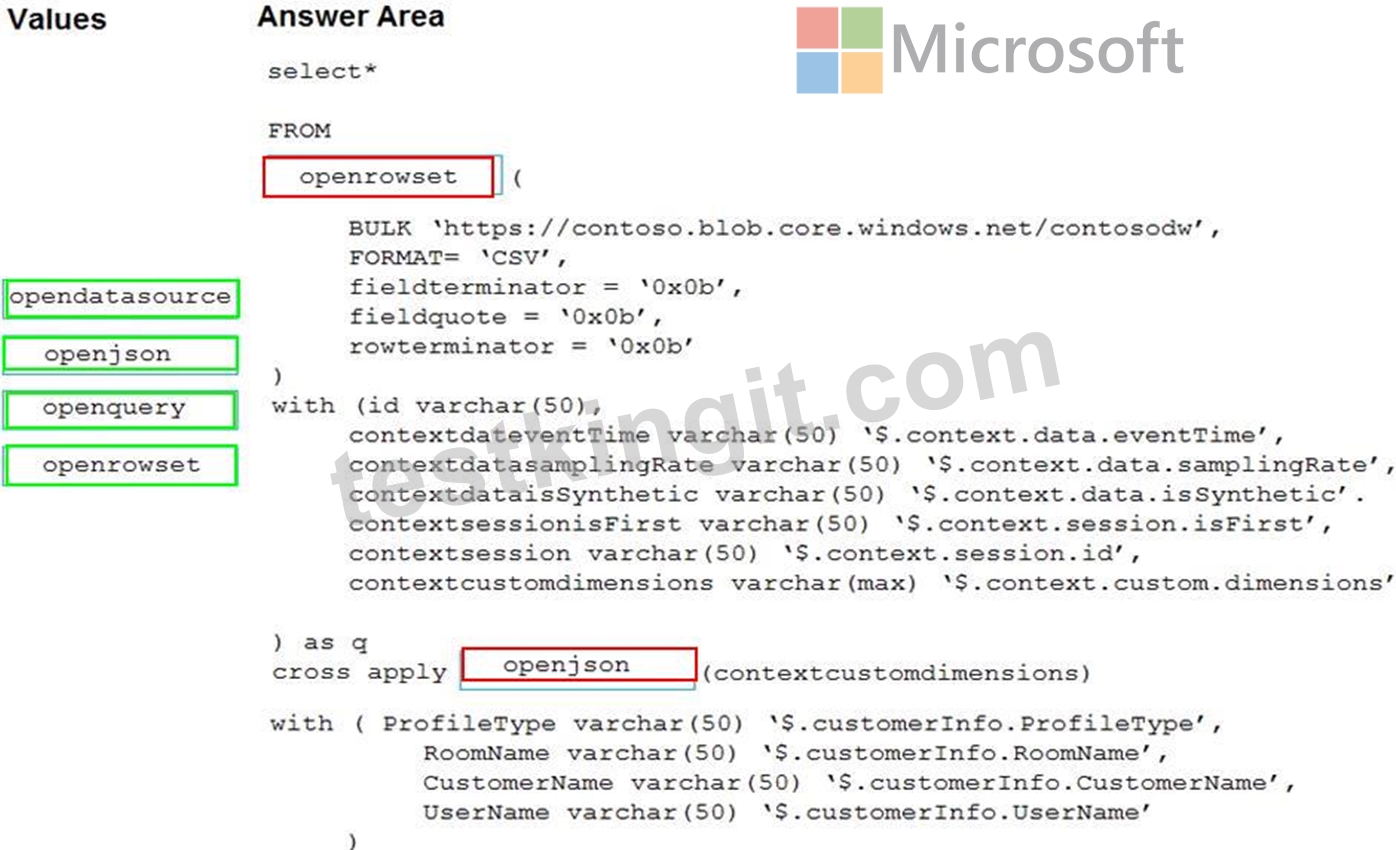
Reference:
https://docs.microsoft.com/en-us/azure/synapse-analytics/sql/query-single-csv-file
https://docs.microsoft.com/en-us/sql/relational-databases/json/import-json-documents-into-sql-server
Topic 1, Litware, inc.
Requirements
Business Goals
Litware wants to create a new analytics environment in Azure to meet the following requirements:
See inventory levels across the stores. Data must be updated as close to real time as possible.
Execute ad hoc analytical queries on historical data to identify whether the loyalty club discounts increase sales of the discounted products.
Every four hours, notify store employees about how many prepared food items to produce based on historical demand from the sales data.
Technical Requirements
Litware identifies the following technical requirements:
Minimize the number of different Azure services needed to achieve the business goals.
Use platform as a service (PaaS) offerings whenever possible and avoid having to provision virtual machines that must be managed by Litware.
Ensure that the analytical data store is accessible only to the company's on-premises network and Azure services.
Use Azure Active Directory (Azure AD) authentication whenever possible.
Use the principle of least privilege when designing security.
Stage Inventory data in Azure Data Lake Storage Gen2 before loading the data into the analytical data store. Litware wants to remove transient data from Data Lake Storage once the data is no longer in use. Files that have a modified date that is older than 14 days must be removed.
Limit the business analysts' access to customer contact information, such as phone numbers, because this type of data is not analytically relevant.
Ensure that you can quickly restore a copy of the analytical data store within one hour in the event of corruption or accidental deletion.
Planned Environment
Litware plans to implement the following environment:
The application development team will create an Azure event hub to receive real-time sales data, including store number, date, time, product ID, customer loyalty number, price, and discount amount, from the point of sale (POS) system and output the data to data storage in Azure.
Customer data, including name, contact information, and loyalty number, comes from Salesforce, a SaaS application, and can be imported into Azure once every eight hours. Row modified dates are not trusted in the source table.
Product data, including product ID, name, and category, comes from Salesforce and can be imported into Azure once every eight hours. Row modified dates are not trusted in the source table.
Daily inventory data comes from a Microsoft SQL server located on a private network.
Litware currently has 5 TB of historical sales data and 100 GB of customer data. The company expects approximately 100 GB of new data per month for the next year.
Litware will build a custom application named FoodPrep to provide store employees with the calculation results of how many prepared food items to produce every four hours.
Litware does not plan to implement Azure ExpressRoute or a VPN between the on-premises network and Azure.
NEW QUESTION # 174
You have an Azure subscription that contains a logical Microsoft SQL server named Server1. Server1 hosts an Azure Synapse Analytics SQL dedicated pool named Pool1.
You need to recommend a Transparent Data Encryption (TDE) solution for Server1. The solution must meet the following requirements:
Track the usage of encryption keys.
Maintain the access of client apps to Pool1 in the event of an Azure datacenter outage that affects the availability of the encryption keys.
What should you include in the recommendation? To answer, select the appropriate options in the answer area.
NOTE: Each correct selection is worth one point.
Answer:
Explanation: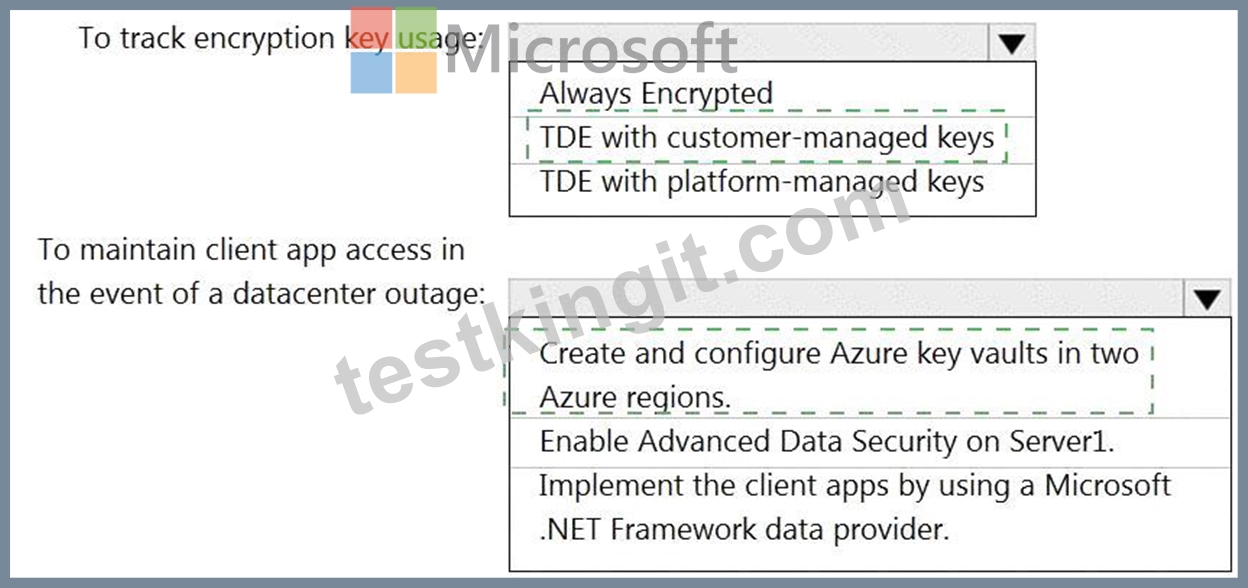
Explanation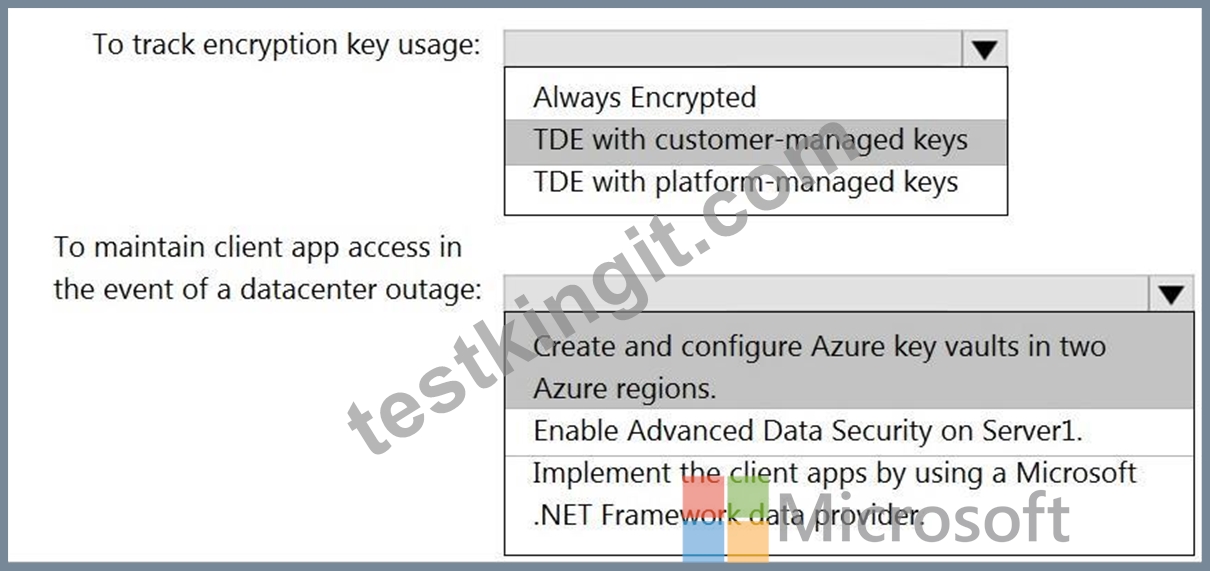
Box 1: TDE with customer-managed keys
Customer-managed keys are stored in the Azure Key Vault. You can monitor how and when your key vaults are accessed, and by whom. You can do this by enabling logging for Azure Key Vault, which saves information in an Azure storage account that you provide.
Box 2: Create and configure Azure key vaults in two Azure regions
The contents of your key vault are replicated within the region and to a secondary region at least 150 miles away, but within the same geography to maintain high durability of your keys and secrets.
Reference:
https://docs.microsoft.com/en-us/azure/synapse-analytics/security/workspaces-encryption
https://docs.microsoft.com/en-us/azure/key-vault/general/logging
NEW QUESTION # 175
You have an Azure Databricks resource.
You need to log actions that relate to changes in compute for the Databricks resource.
Which Databricks services should you log?
- A. DBFS
- B. clusters
- C. SSHE jobs
- D. workspace
Answer: D
Explanation:
Cloud Provider Infrastructure Logs.Databricks logging allows security and admin teams to demonstrate conformance to data governance standards within or from a Databricks workspace. Customers, especially in the regulated industries, also need records on activities like:- User access control to cloud data storage- Cloud Identity and Access Management roles- User access to cloud network and compute Azure Databricks offers three distinct workloads on several VM Instances tailored for your data analytics workflow-the Jobs Compute and Jobs Light Compute workloads make it easy for data engineers to build and execute jobs, and the All-Purpose Compute workload makes it easy for data scientists to explore, visualize, manipulate, and share data and insights interactively.
NEW QUESTION # 176
You need to build a solution to ensure that users can query specific files in an Azure Data Lake Storage Gen2 account from an Azure Synapse Analytics serverless SQL pool.
Which three actions should you perform in sequence? To answer, move the appropriate actions from the list of actions to the answer area and arrange them in the correct order.
NOTE: More than one order of answer choices is correct. You will receive credit for any of the correct orders you select.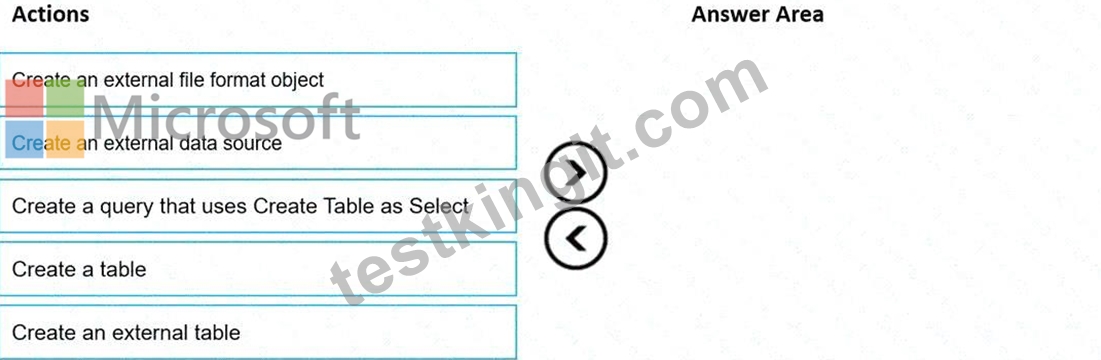
Answer:
Explanation: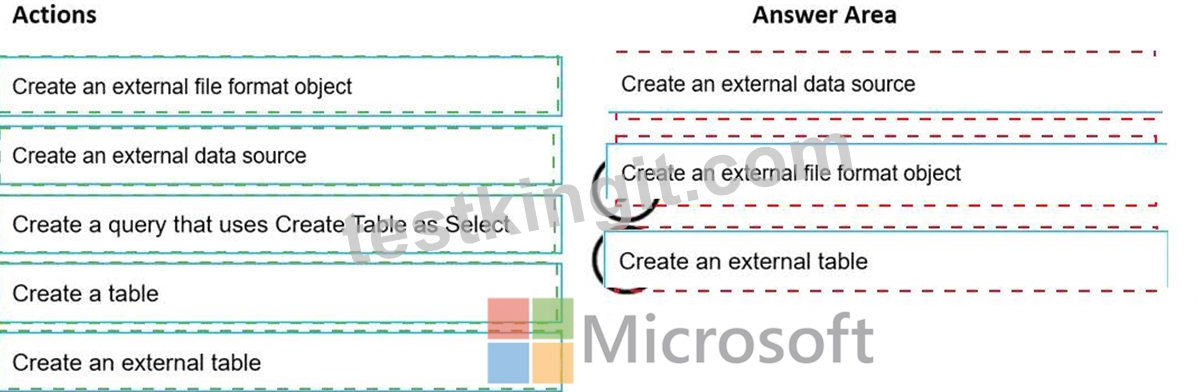
Explanation: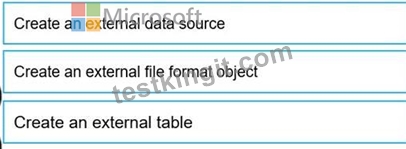
Step 1: Create an external data source
You can create external tables in Synapse SQL pools via the following steps:
CREATE EXTERNAL DATA SOURCE to reference an external Azure storage and specify the credential that should be used to access the storage.
CREATE EXTERNAL FILE FORMAT to describe format of CSV or Parquet files.
CREATE EXTERNAL TABLE on top of the files placed on the data source with the same file format.
Step 2: Create an external file format object
Creating an external file format is a prerequisite for creating an external table.
Step 3: Create an external table
Reference:
https://docs.microsoft.com/en-us/azure/synapse-analytics/sql/develop-tables-external-tables
NEW QUESTION # 177
You are planning the deployment of Azure Data Lake Storage Gen2.
You have the following two reports that will access the data lake:
* Report1: Reads three columns from a file that contains 50 columns.
* Report2: Queries a single record based on a timestamp.
You need to recommend in which format to store the data in the data lake to support the reports. The solution must minimize read times.
What should you recommend for each report? To answer, select the appropriate options in the answer area.
NOTE: Each correct selection is worth one point.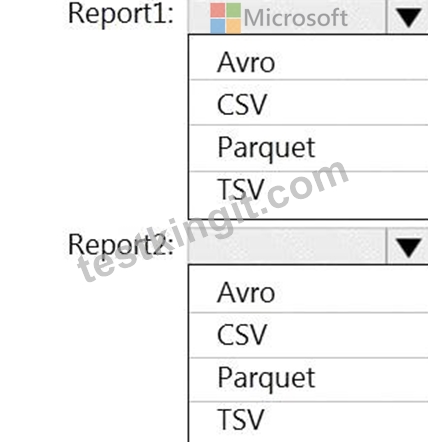
Answer:
Explanation: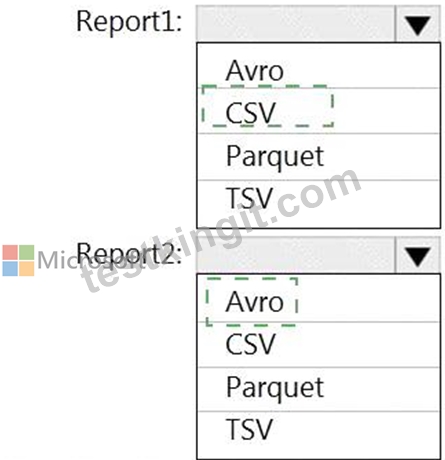
Explanation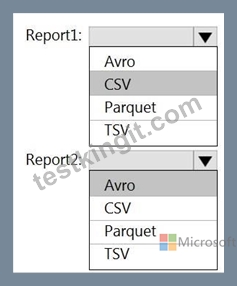
Report1: CSV
CSV: The destination writes records as delimited data.
Report2: AVRO
AVRO supports timestamps.
Not Parquet, TSV: Not options for Azure Data Lake Storage Gen2.
Reference:
https://streamsets.com/documentation/datacollector/latest/help/datacollector/UserGuide/Destinations/ADLS-G2-
NEW QUESTION # 178
You plan to create an Azure Synapse Analytics dedicated SQL pool.
You need to minimize the time it takes to identify queries that return confidential information as defined by the company's data privacy regulations and the users who executed the queues.
Which two components should you include in the solution? Each correct answer presents part of the solution.
NOTE: Each correct selection is worth one point.
- A. sensitivity-classification labels applied to columns that contain confidential information
- B. audit logs sent to a Log Analytics workspace
- C. dynamic data masking for columns that contain confidential information
- D. resource tags for databases that contain confidential information
Answer: A,B
Explanation:
Explanation
A: You can classify columns manually, as an alternative or in addition to the recommendation-based classification: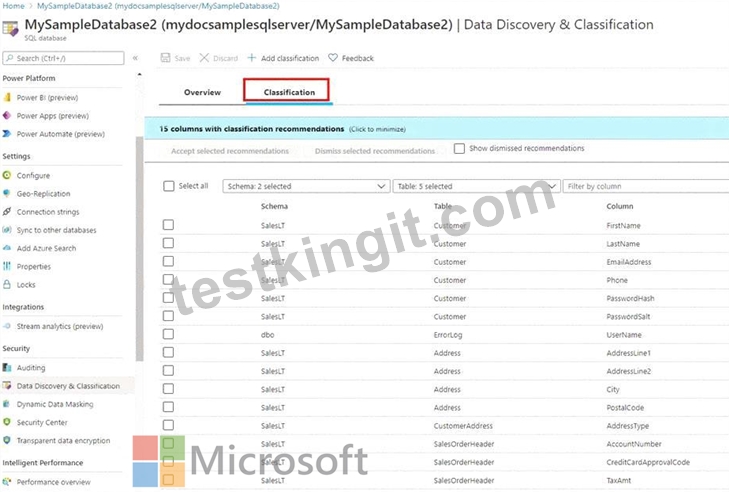
* Select Add classification in the top menu of the pane.
* In the context window that opens, select the schema, table, and column that you want to classify, and the information type and sensitivity label.
* Select Add classification at the bottom of the context window.
C: An important aspect of the information-protection paradigm is the ability to monitor access to sensitive data. Azure SQL Auditing has been enhanced to include a new field in the audit log called data_sensitivity_information. This field logs the sensitivity classifications (labels) of the data that was returned by a query. Here's an example:
Reference:
https://docs.microsoft.com/en-us/azure/azure-sql/database/data-discovery-and-classification-overview
NEW QUESTION # 179
You have a table in an Azure Synapse Analytics dedicated SQL pool. The table was created by using the following Transact-SQL statement.
You need to alter the table to meet the following requirements:
* Ensure that users can identify the current manager of employees.
* Support creating an employee reporting hierarchy for your entire company.
* Provide fast lookup of the managers' attributes such as name and job title.
Which column should you add to the table?
- A. [ManagerEmployeeID] [int] NULL
- B. [ManagerEmployeeID] [smallint] NULL
- C. [ManagerName] [varchar](200) NULL
- D. [ManagerEmployeeKey] [int] NULL
Answer: A
Explanation:
Explanation
Use the same definition as the EmployeeID column.
Reference:
https://docs.microsoft.com/en-us/analysis-services/tabular-models/hierarchies-ssas-tabular
NEW QUESTION # 180
You have an Azure Synapse Analytics dedicated SQL pool that contains the users shown in the following table.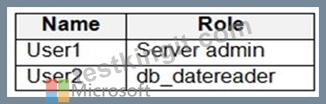
User1 executes a query on the database, and the query returns the results shown in the following exhibit.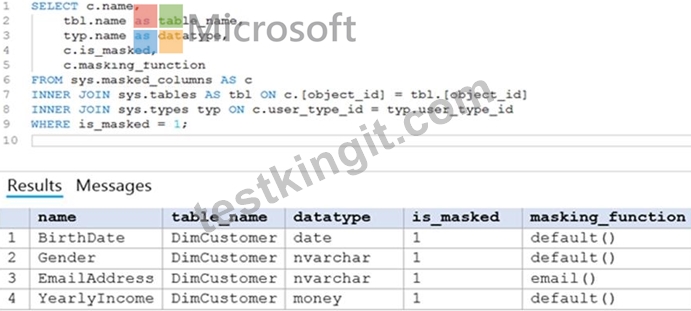
User1 is the only user who has access to the unmasked data.
Use the drop-down menus to select the answer choice that completes each statement based on the information presented in the graphic.
NOTE: Each correct selection is worth one point.
Answer:
Explanation: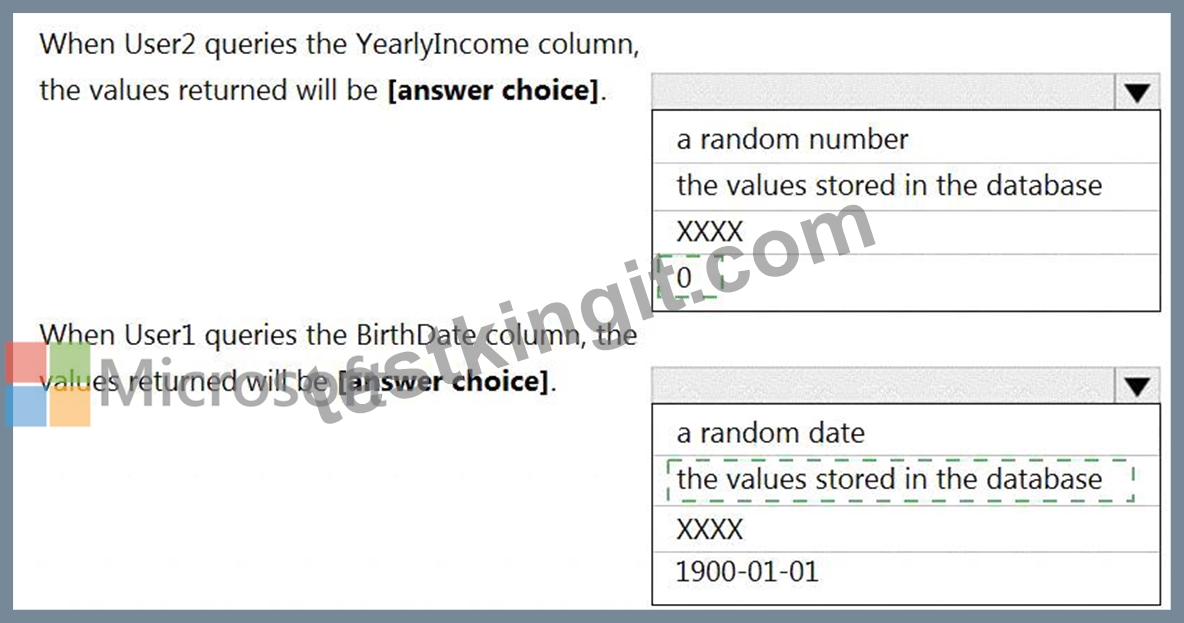
Explanation
Graphical user interface, text, application, email Description automatically generated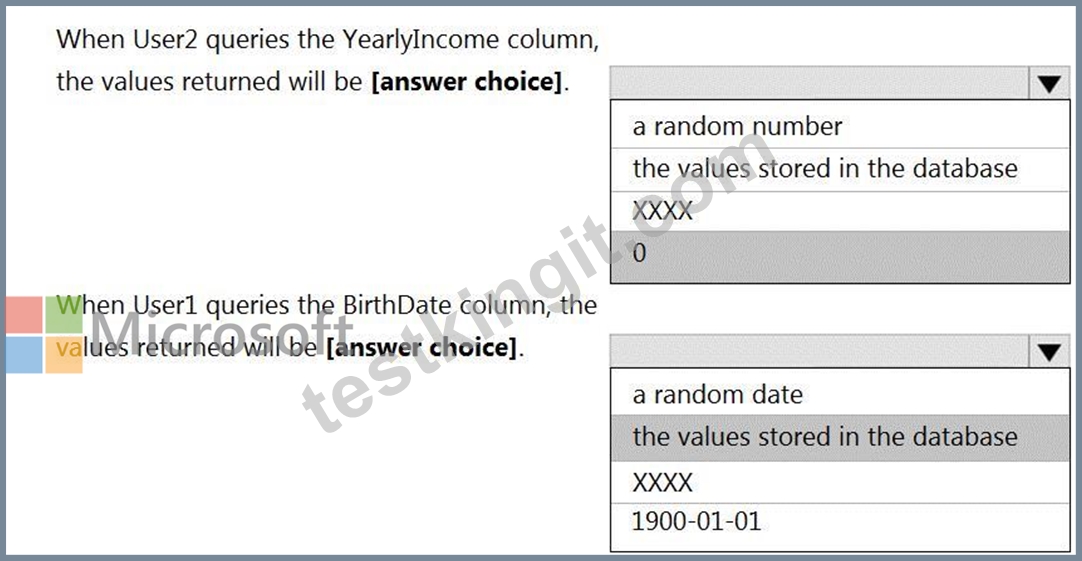
Box 1: 0
The YearlyIncome column is of the money data type.
The Default masking function: Full masking according to the data types of the designated fields
* Use a zero value for numeric data types (bigint, bit, decimal, int, money, numeric, smallint, smallmoney, tinyint, float, real).
Box 2: the values stored in the database
Users with administrator privileges are always excluded from masking, and see the original data without any mask.
Reference:
https://docs.microsoft.com/en-us/azure/azure-sql/database/dynamic-data-masking-overview
NEW QUESTION # 181
You have a self-hosted integration runtime in Azure Data Factory.
The current status of the integration runtime has the following configurations:
Status: Running
Type: Self-Hosted
Running / Registered Node(s): 1/1
High Availability Enabled: False
Linked Count: 0
Queue Length: 0
Average Queue Duration. 0.00s
The integration runtime has the following node details:
Name: X-M
Status: Running
Available Memory: 7697MB
CPU Utilization: 6%
Network (In/Out): 1.21KBps/0.83KBps
Concurrent Jobs (Running/Limit): 2/14
Role: Dispatcher/Worker
Credential Status: In Sync
Use the drop-down menus to select the answer choice that completes each statement based on the information presented.
NOTE: Each correct selection is worth one point.
Answer:
Explanation:
Reference:
https://docs.microsoft.com/en-us/azure/data-factory/create-self-hosted-integration-runtime
NEW QUESTION # 182
You have an Azure Databricks resource.
You need to log actions that relate to changes in compute for the Databricks resource.
Which Databricks services should you log?
- A. SSH
- B. DBFS
- C. clusters
- D. workspace
Answer: D
Explanation:
E jobs
Explanation:
Cloud Provider Infrastructure Logs.
Databricks logging allows security and admin teams to demonstrate conformance to data governance standards within or from a Databricks workspace. Customers, especially in the regulated industries, also need records on activities like:
- User access control to cloud data storage
- Cloud Identity and Access Management roles
- User access to cloud network and compute
Azure Databricks offers three distinct workloads on several VM Instances tailored for your data analytics workflow-the Jobs Compute and Jobs Light Compute workloads make it easy for data engineers to build and execute jobs, and the All-Purpose Compute workload makes it easy for data scientists to explore, visualize, manipulate, and share data and insights interactively.
NEW QUESTION # 183
You have a trigger in Azure Data Factory configured as shown in the following exhibit.
Use the drop-down menus to select the answer choice that completes each statement based upon the information presented in the graphic.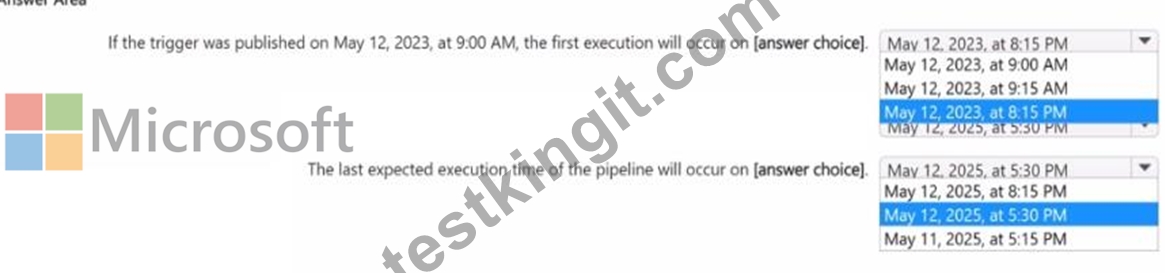
Answer:
Explanation: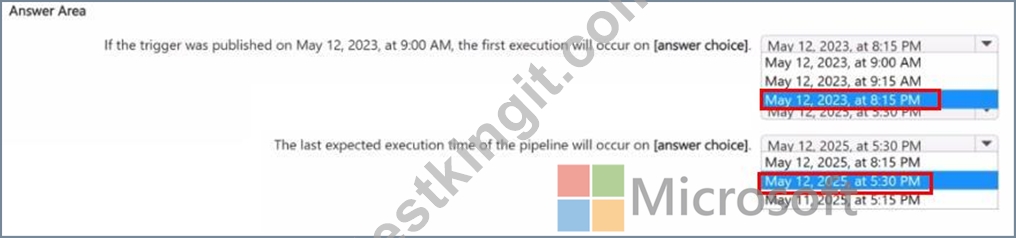
NEW QUESTION # 184
You are designing an application that will store petabytes of medical imaging data When the data is first created, the data will be accessed frequently during the first week. After one month, the data must be accessible within 30 seconds, but files will be accessed infrequently. After one year, the data will be accessed infrequently but must be accessible within five minutes.
You need to select a storage strategy for the data. The solution must minimize costs.
Which storage tier should you use for each time frame? To answer, select the appropriate options in the answer area.
NOTE: Each correct selection is worth one point.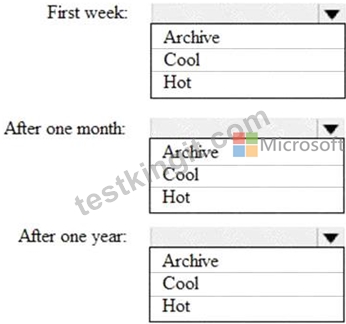
Answer:
Explanation: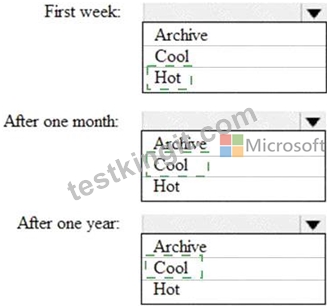
Explanation: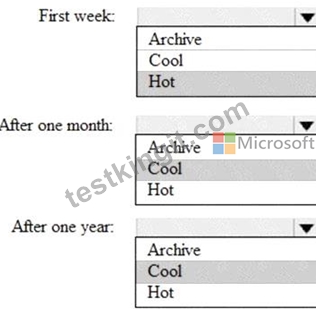
First week: Hot
Hot - Optimized for storing data that is accessed frequently.
After one month: Cool
Cool - Optimized for storing data that is infrequently accessed and stored for at least 30 days.
After one year: Cool
NEW QUESTION # 185
You develop a dataset named DBTBL1 by using Azure Databricks.
DBTBL1 contains the following columns:
* SensorTypeID
* GeographyRegionID
* Year
* Month
* Day
* Hour
* Minute
* Temperature
* WindSpeed
* Other
You need to store the data to support daily incremental load pipelines that vary for each GeographyRegionID.
The solution must minimize storage costs.
How should you complete the code? To answer, select the appropriate options in the answer area.
NOTE: Each correct selection is worth one point.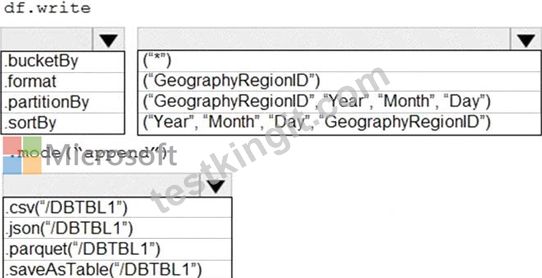
Answer:
Explanation:
Explanation: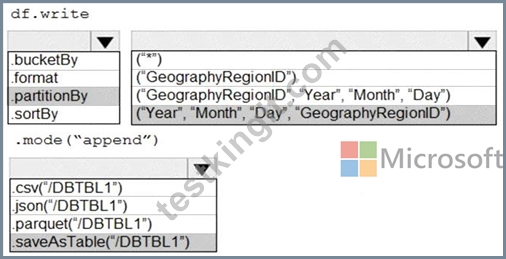
NEW QUESTION # 186
You have an Azure Synapse Analytics dedicated SQL Pool1. Pool1 contains a partitioned fact table named dbo.Sales and a staging table named stg.Sales that has the matching table and partition definitions.
You need to overwrite the content of the first partition in dbo.Sales with the content of the same partition in stg.Sales. The solution must minimize load times.
What should you do?
- A. Switch the first partition from stg.Sales to dbo. Sales.
- B. Switch the first partition from dbo.Sales to stg.Sales.
- C. Update dbo.Sales from stg.Sales.
- D. Insert the data from stg.Sales into dbo.Sales.
Answer: D
NEW QUESTION # 187
......
Use Free DP-203 Exam Questions that Stimulates Actual EXAM : https://selftestengine.testkingit.com/Microsoft/latest-DP-203-exam-dumps.html