

Get Instant Access of 100% Real CompTIA CV0-003 Exam Questions with Verified Answers
Exam Dumps for the Preparation of Latest CV0-003 Exam Questions
The CompTIA CV0-003 exam is intended for individuals with a minimum of two to three years of experience working in the IT industry, particularly in the role of cloud administrators, cloud engineers, and cloud architects. CompTIA Cloud+ Certification Exam certification exam covers a wide range of cloud concepts, including cloud architecture design, deployment, security, and maintenance.
Value of the CompTIA Cloud+ Certification
CompTIA Cloud+ is an internationally-recognized vendor-neutral credential. The certification validates that an IT professional has the knowledge and skills required to perform effectively in data center jobs. Professions span many areas - from technical sales and marketing to risk management, people who touch technology must have a common set of skills and knowledge. CompTIA Cloud+ is the only vendor-neutral, performance-based certification covering more than a specific vendor or a single function, like security or networking. CompTIA Cloud+ validates the skills you need to maintain and optimize cloud infrastructure services. Achieving CompTIA Cloud+ demonstrates your knowledge of cloud models, virtualization, infrastructure, security, resources, and documentation. CompTIA CV0-003 Dumps are the most effective way to pass your exam in first attempt.
It tests the skills you need to perform critical IT tasks making it one of the most relevant certifications available today. For IT professionals who are already experienced in data center administration and want to advance their careers by earning a specialty cloud computing certification. We have a customer care 24/7 for any desktop operations use easily role options. For data center administrators who want to develop a deeper understanding of how to deploy and manage cloud infrastructure services. For individuals who are looking for a stepping stone into more advanced IT roles.
CompTIA CV0-003 exam is a comprehensive exam that covers all aspects of cloud computing. Candidates who pass CV0-003 exam will have a solid understanding of cloud computing technologies and will be able to deploy, manage, and secure cloud-based solutions. CompTIA Cloud+ Certification Exam certification is ideal for IT professionals who want to advance their career in cloud computing or for organizations that want to validate the expertise of their IT staff.
NEW QUESTION # 173
A cloud solution provider offers services solely to the healthcare industry which meets specific security and government regulations. This is an example of which of the following cloud types?
- A. Public
- B. Community
- C. Private
- D. Hybrid
Answer: B
NEW QUESTION # 174
When the protocol HTTP is transmitted over SSL, which of the following ports is used by default?
- A. 0
- B. 1
- C. 2
- D. 3
Answer: D
NEW QUESTION # 175
A systems administrator is planning to migrate to a cloud solution with volume-based licensing. Which of the following is most important when considering licensing costs?
- A. The number of sockets
- B. The number of cores
- C. The number of machines
- D. The number of threads
Answer: C
Explanation:
Explanation
Volume-based licensing is a model where the cost of the software is based on the number of licenses purchased1. This model is commonly used for software that is installed on a specific number of devices, such as antivirus software or office productivity suites1. Therefore, the number of machines is the most important factor when considering licensing costs in this model.
References: CompTIA Cloud+ CV0-003 Exam Objectives, Objective 1.2: Given a scenario, compare and contrast various cloud service models ; Cloud+ Exam CV0-003: CompTIA Cloud+ Licensing Models1
NEW QUESTION # 176
All of a company's servers are currently hosted in one cloud MSP. The company created a new cloud environment with a different MSP. A cloud engineer is now tasked with preparing for server migrations and establishing connectivity between clouds. Which of the following should the engineer perform FIRST?
- A. Migrate the servers.
- B. Peer all the networks from each cloud environment.
- C. Create a VPN tunnel.
- D. Configure network access control lists.
Answer: C
NEW QUESTION # 177
A cloud architect is receiving complaints from VDI users overseas about slowness, even though the remote office has Gigabit internet. Which of the following will most likely solve the issue?
- A. Lowering latency.
- B. Adding redundancy.
- C. Increasing bandwidth.
- D. Enabling compression.
Answer: A
Explanation:
Detailed Explanation:
* C. Lowering latency: Latency affects response times more than bandwidth in high-speed networks.
Techniques like optimizing routing and using edge computing can reduce latency.
References:
* CompTIA Cloud+ CV0-003 Study Guide Chapter 13: Cloud Networking Solutions.
NEW QUESTION # 178
A cloud administrator used a deployment script to recreate a number of servers hosted in a public-cloud provider_ However, after the script completes, the administrator receives the following error when attempting to connect to one of the servers Via SSH from the administrators workstation: CHANGED. Which of the following IS the MOST likely cause of the issue?
- A. The fingerprint on the server's RSA key is different
- B. The cloud provider assigned a new IP address to the server.
- C. The administrator has not copied the public key to the server.
- D. The DNS records need to be updated
Answer: A
Explanation:
Explanation
This error indicates that the SSH client has detected a change in the server's RSA key, which is used to authenticate the server and establish a secure connection. The SSH client stores the fingerprints of the servers it has previously connected to in a file called known_hosts, which is usually located in the ~/.ssh directory.
When the SSH client tries to connect to a server, it compares the fingerprint of the server's RSA key with the one stored in the known_hosts file. If they match, the connection proceeds. If they do not match, the SSH client warns the user of a possible man-in-the-middle attack or a host key change, and aborts the connection.
The most likely cause of this error is that the deployment script has recreated the server with a new RSA key, which does not match the one stored in the known_hosts file. This can happen when a server is reinstalled, cloned, or migrated. To resolve this error, the administrator needs to remove or update the old fingerprint from the known_hosts file, and accept the new fingerprint when connecting to the server again. Alternatively, the administrator can use a tool or service that can synchronize or manage the RSA keys across multiple servers, such as AWS Key Management Service (AWS KMS) 1, Azure Key Vault 2, or HashiCorp Vault 3.
NEW QUESTION # 179
Joe, a customer, wants to implement backup of his replicated VMs so production performance is not affected at the primary site.
Which of the following backup methods would be the MOST appropriate?
- A. Agent-based backup at the secondary site
- B. Mirroring to a third site from the primary site
- C. Snapshot-based backup at the secondary site
- D. Agent-based backup at the primary site
Answer: D
NEW QUESTION # 180
A cloud engineer is responsible for a legacy web application that runs on an on-premises VM environment.
The VM environment is approaching end of life. The engineer needs to migrate the web application to the cloud as quickly as possible because the VM environment has the following limitations:
* The VM environment has a single IOGB disk.
* The VM environment still uses 10Mbps, which leaves a 100Mbps WAN connection underutilized.
* No installation media is available.
Which of the following is the best way to migrate the web application to the cloud?
- A. Use the VM import connector to import the VM into the cloud.
- B. Use object storage to create a backup of the VM and restore data into the cloud instance.
- C. Use import/export to import the VM as a snapshot and attach it to a cloud instance.
- D. Use REST APIs to import an image of the VM into the cloud.
Answer: A
Explanation:
Explanation
A VM import connector is a tool that allows you to import virtual machines from your on-premises environment into the cloud using a graphical user interface. This is the fastest and easiest way to migrate a legacy web application without requiring installation media or changing the configuration of the VM. The VM import connector can also handle the disk size and network bandwidth limitations of the on-premises VM environment. References: EC2 VM Import Connector | AWS News Blog, Import a VMware Virtual Machine to Oracle Cloud Infrastructure, CompTIA Cloud+ Certification Exam Objectives, Domain 2.0: Deployment, Objective 2.1: Given a scenario, execute and implement solutions using appropriate cloud migration tools and methods.
NEW QUESTION # 181
A VDI administrator has received reports from the drafting department that rendering is slower than normal. Which of the following should the administrator check FIRST to optimize the performance of the VDI infrastructure?
- A. Storage
- B. CPU
- C. Memory
- D. GPU
Answer: C
NEW QUESTION # 182
A VDI administrator has received reports from the drafting department that rendering is slower than normal. Which of the following should the administrator check FIRST to optimize the performance of the VDI infrastructure?
- A. Storage
- B. CPU
- C. Memory
- D. GPU
Answer: C
Explanation:
https://www.computer.org/publications/tech-news/trends/7-tips-for-faster-3d-rendering
NEW QUESTION # 183
A cloud administrator is assigned to establish a connection between the on-premises data center and the new CSP infrastructure. The connection between the two locations must be secure at all times and provide service for all users inside the organization. Low latency is also required to improve performance during data transfer operations. Which of the following would BEST meet these requirements?
- A. A point-to-site VPN
- B. A VPC peering configuration
- C. An IPSec tunnel
- D. An MPLS connection
Answer: C
Explanation:
An IPSec tunnel is what would best meet the requirements of establishing a connection between the on-premises data center and the new CSP infrastructure that is secure at all times and provides service for all users inside the organization with low latency. IPSec (Internet Protocol Security) is a protocol that encrypts and secures network traffic over IP networks. IPSec tunnel is a mode of IPSec that creates a virtual private network (VPN) tunnel between two endpoints, such as routers, firewalls, gateways, etc., and encrypts and secures all traffic that passes through it. An IPSec tunnel can meet the requirements by providing:
Security: An IPSec tunnel can protect network traffic from interception, modification, spoofing, etc., by using encryption, authentication, integrity, etc., mechanisms.
Service: An IPSec tunnel can provide service for all users inside the organization by allowing them to access and use network resources or services on both ends of the tunnel, regardless of their physical location.
Low latency: An IPSec tunnel can provide low latency by reducing the number of hops or devices that network traffic has to pass through between the endpoints of the tunnel.
NEW QUESTION # 184
A systems administrator is attempting to gather information about services and resource utilization on VMS in a cloud environment. Which of the following will BEST accomplish this objective?
- A. CMDB
- B. Performance monitoring
- C. SNMP
- D. Service management
- E. Syslog
Answer: B
Explanation:
Performance monitoring is the process of collecting and analyzing metrics related to the performance and availability of resources in a cloud environment1. Performance monitoring can help a systems administrator to gather information about services and resource utilization on VMs in a cloud environment by providing the following benefits2:
Identify and troubleshoot performance issues and bottlenecks before they affect the end users or business operations.
Optimize the resource allocation and configuration to meet the performance requirements and SLAs of the services.
Plan for future capacity and scalability needs based on the historical trends and patterns of resource utilization.
Compare the performance and costs of different cloud service providers, regions, and SKUs.
Some of the tools and services that can help with performance monitoring in a cloud environment are3:
Azure Monitor: A comprehensive service that provides a unified view of the health, performance, and availability of your Azure resources, applications, and services. Azure Monitor collects metrics, logs, and traces from various sources and provides analysis, visualization, alerting, and automation capabilities.
Azure Advisor: A personalized service that provides recommendations to optimize your Azure resources for performance, security, cost, reliability, and operational excellence. Azure Advisor analyzes your resource configuration and usage data and suggests best practices to improve your cloud environment.
Azure Application Insights: A service that monitors the performance and usage of your web applications and services. Application Insights collects telemetry data such as requests, dependencies, exceptions, page views, custom events, and metrics from your application code and provides powerful analytics, diagnostics, and alerting features.
Azure Log Analytics: A service that collects and analyzes data from various sources such as Azure Monitor, Azure services, VMs, containers, applications, and other cloud or on-premises systems. Log Analytics enables you to query, visualize, and correlate log data using the Kusto Query Language (KQL) and create custom dashboards and reports.
Syslog is a standard protocol for sending log messages from network devices to a central server. Syslog can help with logging and auditing activities in a cloud environment, but it does not provide performance monitoring capabilities. Therefore, option A is incorrect.
SNMP (Simple Network Management Protocol) is a protocol for collecting and organizing information about managed devices on a network. SNMP can help with network management and monitoring in a cloud environment, but it does not provide comprehensive performance monitoring for VMs and services. Therefore, option B is incorrect.
CMDB (Configuration Management Database) is a database that stores information about the configuration items (CIs) in an IT environment. CMDB can help with configuration management and change management in a cloud environment, but it does not provide performance monitoring capabilities. Therefore, option C is incorrect.
Service management is a set of processes and practices that aim to deliver value to customers by providing quality services that meet their needs and expectations. Service management can help with service design, delivery, support, and improvement in a cloud environment, but it does not provide performance monitoring capabilities. Therefore, option D is incorrect.
NEW QUESTION # 185
A company that performs passive vulnerability scanning at its transit VPC has detected a vulnerability related to outdated web-server software on one of its public subnets. Which of the following can the use to verify if this is a true positive with the LEAST effort and cost? (Select TWO).
- A. A network-based scan
- B. A credentialed scan
- C. An agent-based scan
- D. A blue-team exercise
- E. A red-team exercise
- F. Unknown environment penetration testing
- G. A port scan
Answer: B,C
Explanation:
Explanation
The correct answer is B and E. An agent-based scan and a credentialed scan can help verify if the vulnerability related to outdated web-server software is a true positive with the least effort and cost.
An agent-based scan is a type of vulnerability scan that uses software agents installed on the target systems to collect and report data on vulnerabilities. This method can provide more accurate and detailed results than a network-based scan, which relies on network traffic analysis and probes1. An agent-based scan can also reduce the network bandwidth and performance impact of scanning, as well as avoid triggering false alarms from intrusion detection systems2.
A credentialed scan is a type of vulnerability scan that uses valid login credentials to access the target systems and perform a more thorough and comprehensive assessment of their configuration, patch level, and vulnerabilities. A credentialed scan can identify vulnerabilities that are not visible or exploitable from the network level, such as missing updates, weak passwords, or misconfigured services3. A credentialed scan can also reduce the risk of false positives and false negatives, as well as avoid causing damage or disruption to the target systems3.
A network-based scan, a port scan, a red-team exercise, a blue-team exercise, and unknown environment penetration testing are not the best options to verify if the vulnerability is a true positive with the least effort and cost. A network-based scan and a port scan may not be able to detect the vulnerability if it is not exposed or exploitable from the network level. A red-team exercise, a blue-team exercise, and unknown environment penetration testing are more complex, time-consuming, and costly methods that involve simulating real-world attacks or defending against them. These methods are more suitable for testing the overall security posture and resilience of an organization, rather than verifying a specific vulnerability4.
NEW QUESTION # 186
A company is migrating workloads from on premises to the cloud and would like to establish a connection between the entire data center and the cloud environment. Which of the following VPN configurations would accomplish this task?
- A. Site-to-site
- B. Point-to-point
- C. Client-to-site
- D. Point-to-site
Answer: A
Explanation:
Explanation
A site-to-site VPN is a type of VPN configuration that establishes a secure connection between two networks, such as a data center and a cloud environment. A site-to-site VPN allows all the devices in one network to communicate with all the devices in the other network, without requiring individual VPN clients or connections. A site-to-site VPN is suitable for a company that is migrating workloads from on premises to the cloud and would like to establish a connection between the entire data center and the cloud environment, as it can provide seamless and secure access to both networks.
NEW QUESTION # 187
A cloud engineer is responsible for managing a public cloud environment. There is currently one virtual network that is used to host the servers in the cloud environment. The environment is rapidly growing, and the network does not have any more available IP addresses. Which of the following should the engineer do to accommodate additional servers in this environment?
- A. Implement dynamic routing.
- B. Enable DHCP on the networks.
- C. Create a VPC and peer the networks.
- D. Obtain a new IPAM subscription.
Answer: C
NEW QUESTION # 188
A systems administrator is configuring a storage array.
Which of the following should the administrator configure to set up mirroring on this array?
- A. RAID 1
- B. RAID 5
- C. RAID 6
- D. RAID 0
Answer: A
Explanation:
Explanation
RAID 1 is a type of RAID level that creates an exact copy or mirror of data on two or more disks. RAID 1 can provide redundancy and fault tolerance, as it can survive the failure of one disk without losing any data. RAID
1 can also improve read performance, as it can access data from multiple disks simultaneously. The administrator should configure RAID 1 to set up mirroring on a storage array. References: CompTIA Cloud+ Certification Exam Objectives, page 9, section 1.4
NEW QUESTION # 189
A systems administrator is reviewing two CPU models for a cloud deployment. Both CPUs have the same number of cores/threads and run at the same clock speed.
Which of the following will BEST identify the CPU with more computational power?
- A. Simultaneous multithreading
- B. Bus speed
- C. Instructions per cycle
- D. L3 cache
Answer: C
Explanation:
Instructions per cycle (IPC) is a metric that measures how many instructions a CPU can execute in one clock cycle. IPC can help identify the CPU with more computational power when comparing two CPU models that have the same number of cores/threads and run at the same clock speed, as it indicates the efficiency and performance of the CPU architecture and design. A higher IPC means that the CPU can process more instructions in less time, resulting in faster and better performance. Reference: CompTIA Cloud+ Certification Exam Objectives, page 9, section 1.4
NEW QUESTION # 190
Which of the following will mitigate the risk of users who have access to an instance modifying the system configurations?
- A. Implement whole-disk encryption
- B. Deploy the latest OS patches
- C. Implement mandatory access control
- D. Deploy an anti-malware solution
Answer: C
Explanation:
Mandatory access control (MAC) is a type of access control model that enforces strict security policies based on predefined rules and labels. MAC assigns security labels to subjects (users or processes) and objects (files or resources) and allows access only if the subject has the appropriate clearance and need-to-know for the object. MAC can mitigate the risk of users who have access to an instance modifying the system configurations, as it can prevent unauthorized or accidental changes to critical files or settings by restricting access based on predefined rules and labels. References: CompTIA Cloud+ Certification Exam Objectives, page 14, section 2.7
NEW QUESTION # 191
A systems administrator needs to implement a service to protect a web application from external attacks. The administrator must have session-based granular control of all HTTP traffic. Which of the following should the administrator configure?
- A. WAF
- B. NAC
- C. DLP
- D. IDS
Answer: A
Explanation:
Reference:
A web application firewall (WAF) is a type of firewall that monitors and filters HTTP traffic to and from a web application. It can detect and block malicious requests, such as SQL injection, cross-site scripting, or denial-of-service attacks. It can also provide session-based granular control of HTTP traffic, such as allowing or denying access based on user identity, location, or behavior. Reference: CompTIA Cloud+ Certification Exam Objectives, Domain 2.0 Security, Objective 2.2 Given a scenario, implement appropriate network security controls for a cloud environment.
NEW QUESTION # 192
A systems administrator would like to reduce the network delay between two servers.
Which of the following will reduce the network delay without taxing other system resources?
- A. Adjust the CPU resources on both servers
- B. Enable compression between the servers
- C. Configure a VPN tunnel between the servers
- D. Decrease the MTU size on both servers
Answer: D
Explanation:
The maximum transmission unit (MTU) is the largest size of a packet or frame that can be sent over a network. Decreasing the MTU size on both servers can reduce the network delay between them, as it can reduce the fragmentation and reassembly of packets, improve the transmission efficiency, and avoid packet loss or errors. Decreasing the MTU size can also avoid taxing other system resources, as it does not require additional CPU, memory, or disk resources. References: CompTIA Cloud+ Certification Exam Objectives, page 16, section 3.2 Reference: https://cseweb.ucsd.edu/~calder/papers/HPDC-01-DynComp.pdf
NEW QUESTION # 193
A highly regulated business is required to work remotely, and the risk tolerance is very low. You are tasked with providing an identity solution to the company cloud that includes the following:
* secure connectivity that minimizes user login
* tracks user activity and monitors for anomalous activity
* requires secondary authentication
INSTRUCTIONS
Select controls and servers for the proper control points.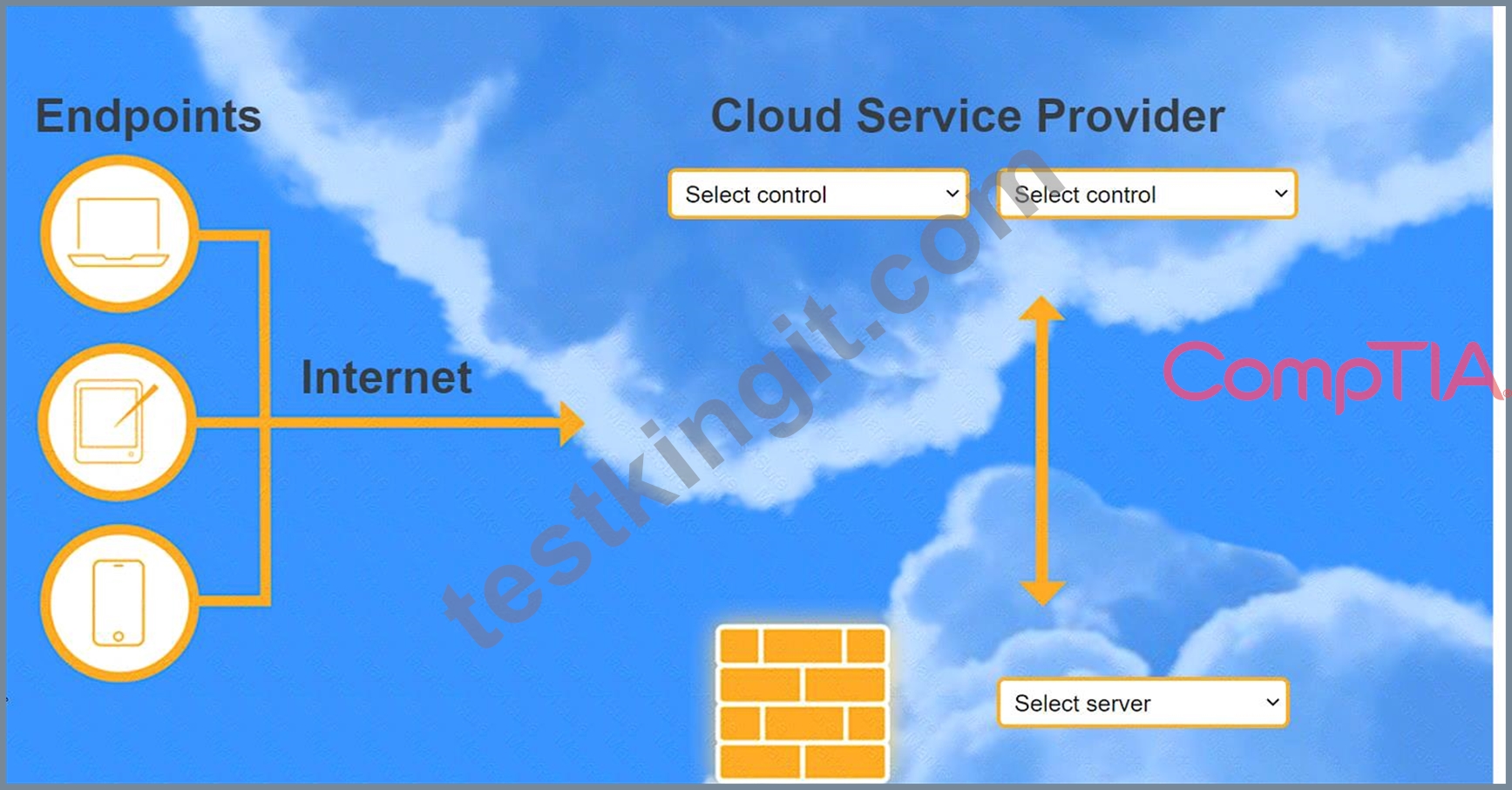

Answer:
Explanation:
Explanation:
VPN Client
MFA
SIEM
NEW QUESTION # 194
An organization is running a database application on a SATA disk, and a customer is experiencing slow performance most of the time.
Which of the following should be implemented to improve application performance?
- A. Upgrade the environment and use SSD drives
- B. Increase the memory and network bandwidth
- C. Upgrade the application
- D. Increase disk capacity
Answer: A
Explanation:
Upgrading the environment and using solid state drives (SSDs) can improve application performance for a database application that is running on a serial advanced technology attachment (SATA) disk and experiencing slow performance most of the time. Upgrading the environment can involve updating or replacing the hardware, software, or network components that support the application to enhance their functionality, capacity, or compatibility. Using SSDs can provide faster and more reliable data access and storage than SATA disks, as they use flash memory instead of spinning disks to store data. SSDs can also reduce latency, power consumption, and heat generation. Reference: CompTIA Cloud+ Certification Exam Objectives, page 9, section 1.4
NEW QUESTION # 195
A cloud engineer is responsible for managing two cloud environments from different MSPs. The security department would like to inspect all traffic from the two cloud environments.
Which of the following network topology solutions should the cloud engineer implement to reduce long-term maintenance?
- A. Chain
- B. Hub and spoke
- C. Star
- D. Mesh
Answer: B
Explanation:
Explanation
Hub and spoke is a type of network topology that consists of a central node or device (hub) that connects to multiple peripheral nodes or devices (spokes). Hub and spoke can help reduce long-term maintenance for managing two cloud environments from different MSPs, as it can simplify and centralize the network configuration and management by using the hub as a single point of contact and control for the spokes. Hub and spoke can also improve network performance and security, as it can reduce latency, bandwidth consumption, and network congestion by routing traffic through the hub. References: CompTIA Cloud+ Certification Exam Objectives, page 15, section 2.8
NEW QUESTION # 196
SIMULATION
The QA team is testing a newly implemented clinical trial management (CTM) SaaS application that uses a business intelligence application for reporting. The UAT users were instructed to use HTTP and HTTPS.
Refer to the application dataflow:
1A - The end user accesses the application through a web browser to enter and view clinical data.
2A - The CTM application server reads/writes data to/from the database server.
1B - The end user accesses the application through a web browser to run reports on clinical data.
2B - The CTM application server makes a SOAP call on a non-privileged port to the BI application server.
3B - The BI application server gets the data from the database server and presents it to the CTM application server.
When UAT users try to access the application using https://ctm.app.com or http://ctm.app.com, they get a message stating: "Browser cannot display the webpage." The QA team has raised a ticket to troubleshoot the issue.
INSTRUCTIONS
You are a cloud engineer who is tasked with reviewing the firewall rules as well as virtual network settings.
You should ensure the firewall rules are allowing only the traffic based on the dataflow.
You have already verified the external DNS resolution and NAT are working.
Verify and appropriately configure the VLAN assignments and ACLs. Drag and drop the appropriate VLANs to each tier from the VLAN Tags table. Click on each Firewall to change ACLs as needed.
If at any time you would like to bring back the initial state of the simulation, please click the Reset All button.


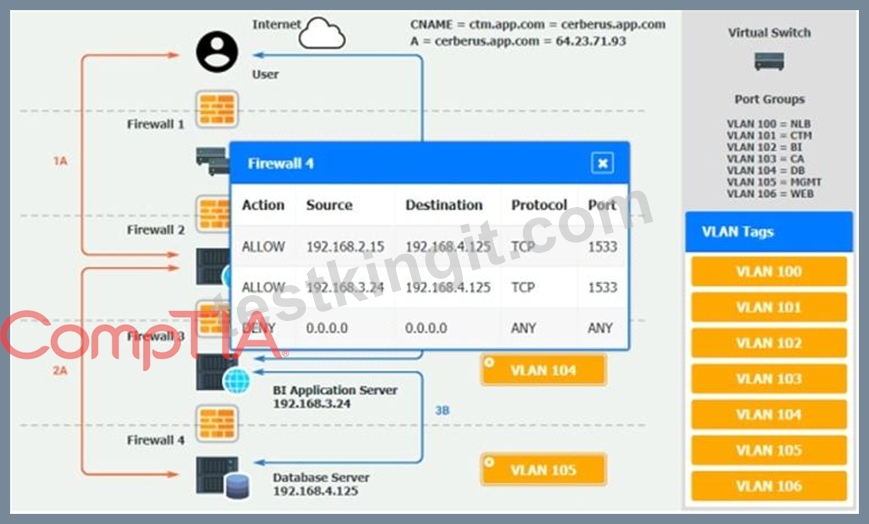
- A. On firewall 3, change the DENY 0.0.0.0 entry to rule 3 not rule 1.
- B. On firewall 3, change the DENY 0.8.8.0 entry to rule 3 not rule 1.
Answer: A
NEW QUESTION # 197
An organization is hosting a cloud-based web server infrastructure that provides web-hosting solutions. Sudden continuous bursts of traffic have caused the web servers to saturate CPU and network utilizations.
Which of the following should be implemented to prevent such disruptive traffic from reaching the web servers?
- A. Solutions to perform NAC and DLP
- B. QoS on the network
- C. DDoS protection
- D. A solution to achieve microsegmentation
Answer: C
Explanation:
Distributed denial-of-service (DDoS) protection is a type of security solution that detects and mitigates DDoS attacks that aim to overwhelm or disrupt a system or service by sending large volumes of traffic from multiple sources. DDoS protection can prevent such disruptive traffic from reaching the web servers by filtering out malicious or unwanted traffic and allowing only legitimate traffic to pass through. DDoS protection can also help maintain the availability and functionality of web services and applications during a DDoS attack. Reference: CompTIA Cloud+ Certification Exam Objectives, page 14, section 2.7
NEW QUESTION # 198
......
Download Latest & Valid Questions For CompTIA CV0-003 exam: https://selftestengine.testkingit.com/CompTIA/latest-CV0-003-exam-dumps.html